The post Shark Wet and Dry Vac Review: Never Cry Over Spilled Milk Again appeared first on Taste of Home.
]]>Instead of wasting sheets of paper towel or dealing with dozens of rags in the washer, there’s another solution. It requires zero elbow grease, no mopping and, better still, it’s absolutely foolproof. When life gets messy, it’s time to pull out the Shark MessMaster, the Shark wet and dry vac of my dreams.

Shark MessMaster Wet and Dry Vac
The Shark wet and dry vac makes cleaning up spills and pet messes simple. Bonus: no more mop buckets and stained towels!
What is the Shark Wet and Dry Vac?
The Shark MessMaster is a Shark wet and dry vac that sucks up almost anything. Unlike traditional vacuums, it uses an attached hose for suction. The industrial look and feel make it more closely resembles a shop vac than an upright vacuum. That said, it’s capable of messes that even a shop vacuum wouldn’t touch, like standing water or organic spills. And the best part? It actually cleans itself. No more touching gross, sloppy pet messes!
How We Tested It
At the time of publication, I’ve tested the Shark wet and dry vacuum in my home for a month. In this time it took care of many messes, from kitchen and pet snafus to wet and dry spills.
Unboxing and Setup

The MessMaster arrived well-packed with a quick-start guide printed on the interior box flaps. Using this guide, I quickly had the vacuum up and running. It’s simply a matter of attaching the hose to the unit, snapping on the accessory holder and adding a bag to the dust bin. Everything else inside the vacuum is readily assembled.
Its hose attaches to its main body, which houses the dust canister, three filters and onboard accessory storage for its myriad included attachments. The top of the vacuum features a handle, which makes it easy to move from room to room.
The bin bag is optional and the unit comes with two to start off. Any 12- to 13-gallon plastic bag fits, making it easy to replace them over time. Additionally, the accessory holder houses up to two accessories. As a minor gripe, I do wish there were more slots since my unit came with two accessories that don’t have a place to dock.
Overall, the setup process took about 15 minutes from unboxing to vacuuming.
Attachments

My machine (the VS101 model) came with several attachments. These include a crevice tool, squeegee tool, carpet tool, three-piece extension wand and an accessory holder that houses up to two attachments. Some other models come with additional accessories including an under-appliance wand, pet multi-tool,, duster crevice tool, anti-allergen brush, upholstery tool and bare floor tool. These are also available separately for purchase on the Shark website, as are any spare parts needed for repair.
Performance
Once set up, it’s literally plug-and-play. The machine is corded, but the cord is long at around 20 feet. This makes it easier to do miscellaneous tasks, like using the vacuum in my garage or my car. It also ensures that you can pretty much tackle an entire medium-sized room without moving from outlet to outlet, which I love. Not that the MessMaster is difficult to move—it weighs just over nine pounds and has a useful handle on top.
The handle also doubles as cord storage. Just wrap the cord around the handle and use the clamp near the plug to secure it to itself. Similarly, the hose has a little docking station on the front that keeps it secure between uses.
Coffee Grounds on Carpet

Normally, vacuuming up used coffee grounds is a near-instant way to ruin your Shark or Dyson stick vacuum. However, the Shark wet and dry vac can handle messes that most other vacuums can’t. To test this, I dumped some used coffee grounds from my Keurig machine onto my carpet. I popped on the carpet attachment for this task, which is a wider version of the squeegee tool.
While I expected good performance, I am honestly amazed at the suction this little machine creates. Moving the hose over the grounds made them all instantly disappear. I only had to do a single pass! And, best of all, the grounds didn’t diminish the machine’s suction whatsoever on subsequent tests.
Egg on Hard Floor

If you’ve ever accidentally dropped an egg onto a hard floor, you know the frustration of getting all the goo and shell bits off the ground. A few weeks prior to owning the MessMaster, my cat casually knocked one onto my kitchen floor. It took nearly a whole roll of paper towels and several passes with a mop to restore my floor to its former egg-free glory. I knew this was the perfect test.
With my MessMaster in hand, I reenacted my egg experience. Only this time, it was me who dropped it from several feet above the floor—and boy, did it splatter. MessMaster, to the rescue! I brought the squeegee attachment close to the egg and watched in awe as the entire thing—including shell bits, yolk and sticky whites—flew right into the machine via the hose.
To ensure the floor was nice and disinfected, I used a trick from Shark’s instruction manual, which mentions spraying the area with disinfecting cleaner and then going back in with the squeegee tool rather than wiping it dry with a cloth. By the time I was finished, the floor was just as clean as before—and I didn’t dirty one rag or paper towel in the process!
Pet Messes
While this Shark vacuum isn’t aimed at pet messes per se—at least, not like the dedicated Cordless Pet Plus—it is good for difficult pet messes. Yes, you can use it for “organic” messes (if you catch my drift), but it’s also great for other pet-related perils.
Take clumping cat litter, which normally is a no-no in a vacuum since it wreaks havoc on interior parts. I’ve actually ruined a vacuum doing this in the past, so it took some mental encouragement for me to try it again with the MessMaster. However, I’m genuinely surprised how fast and easy it is to suck up stray cat litter around my girls’ boxes. And the best part? No clogs!
That said, it’s not a replacement for a regular handheld vacuum when it comes to clearing fluff off upholstery. While the carpet tool works decently for debris on rugs and floors, it simply isn’t stiff enough to work hair out from couches and cat trees. For that, stick to our favorite cordless vacuums instead.
Emptying and Cleaning

As most would imagine, the Shark wet and dry vacuum gets pretty filthy after tackling all those wet messes. Luckily, it’s also a breeze to clean. After picking up a wet or organic mess, vacuum up a cup filled with standard tap water to engage a rinse cycle. If needed, do this a couple of times to ensure that all the internal parts are thoroughly rinsed. From there, just dump the contents out of the dust bin and give it a rinse in the sink. For a deeper clean, the attachments and dust bin are all dishwasher safe.
In case of any splatters on the inside of the lid, it’s easily detached for a quick rinse in the sink. The MessMaster also includes three filters: a cone filter, a sponge filter and a round filter. These require a rinse cleaning once a month. Just be sure to set them out to dry before replacing them back into the machine.
Pros
- Easily tackles both wet and dry messes
- Numerous accessories included
- Self-cleaning
- Works with and without bags
- Very lightweight at under 10 pounds
- Long, 20-foot cord
- Simple setup
Cons
- Needs more onboard accessory storage
- Cord storage is a little annoying
- Not ideal for pet hair
Final Verdict
Overall, I’m extremely happy with my MessMaster. While it’s not a replacement for a standard cordless vacuum, it is an indispensable tool in my cleaning arsenal. I break it out when I encounter messes that my normal vacuum can’t handle, especially really gross ones. After having it handy for a month of spills and pet messes, I really can’t imagine going back to paper towels and mops.
Sure, you can spring for a vacuum mop that does some of the same things. But even a vacuum mop can’t pick up things like cat litter, used coffee grounds, plant debris and endless dust from DIY projects. Bonus: the MessMaster also hasn’t spit anything back out in the process of moving it from place-to-place, which I can’t say about my current vacuum.
Where to Buy the Shark MessMaster

Shark MessMaster Wet and Dry Vac
The Shark MessMaster sucks up spills, soil and pretty much anything that stains or sticks.
If you’re ready to say sayonara to stubborn, sticky or sloppy messes, snag the Shark MessMaster from the Shark website for around $170. You can also find it at additional retailers, including Chewy, Walmart and Home Depot. It’s so useful to have it handy when spills strike—especially if you’re fresh out of paper towels!
FAQ
How to clean the Shark MessMaster?
Cleaning the Shark MessMaster is as easy as sucking up messes. For dry messes, simply empty the dust bin (or dust bag, if using) into the trash can. If there’s any debris leftover, simply rinse out the bin and wipe it dry.
For wet or organic messes, fill a bowl with water and use the MessMaster to suck it up, then empty it into a sink or receptacle. Do this as many times as needed to thoroughly clear debris from the components. For stubborn messes, rinse the hose, dust bin and attachments under running water. Then, remove the mesh, foam and sponge filters and allow them to air dry before adding them back into the machine.
Is the Shark MessMaster cordless?
No, the Shark MessMaster is not cordless. However, the cord is 20 feet long and the vacuum itself is lightweight at under 10 pounds, which gives it good mobility.
Why You Should Trust Us
When it comes to cleaning products, our Product Testing Team aren’t just testers—they’re users, too! We all have homes to keep tidy, and when a product impresses us, we bring it home and make it a part of our regular cleaning routine. I’ve personally tried so many different devices in my house that I have a pretty good idea about what features are necessary and which are “extra.” Finding the best cleaning equipment means more than just trying it out once in a lab—that’s why we long term test all the products we recommend.
The post Shark Wet and Dry Vac Review: Never Cry Over Spilled Milk Again appeared first on Taste of Home.
]]>The post How to Properly Clean Thrifted Dishes So You Don’t Ruin Them appeared first on Taste of Home.
]]>Vintage ceramic, china and glassware need special care due to their delicate finishes and materials. We’re breaking down the best cleaning method to make your thrifted dishes sparkle without ruining the finish.
How to Clean Vintage Glassware, Ceramic and China

The first step to cleaning vintage glassware and dishware is to skip the dishwasher. The movement in the dishwasher, harsh soap and extreme temperature changes can damage dishes and cause glassware to crack or shatter. Here’s how to hand-wash vintage dishes with care:
- Prepare the sink: Make sure your sink is clean before washing vintage dishes. Lay a folded towel in the bottom of your sink for cushioning, then fill the sink with warm water and a small amount of gentle dish soap.
- Wash: Wash the dishes and glasses one piece at a time. Gently clean with a soft microfiber cloth. If it’s hard to reach the inside of a glass, you can use a stemware brush with soft foam bristles like this one.
- Rinse: Rinse thoroughly with warm water.
- Dry: After rinsing, place the dishes and the glassware upside down on a soft towel to air dry. Or you can hand dry carefully with a soft lint-free cloth.
Extra Tips for Cleaning Vintage Glassware
What to do if you see a cloudy film
You may notice a white or gray film on antique or vintage glasses. According to the American Cleaning Institute, to remove the cloudy film, “Soak [the glassware] in a weak vinegar and water solution for an hour or two. The vinegar (acetic acid) eats away the build up.” You’ll have sparkling glasses again in no time.
How to check if your vintage glassware contains lead
Antique dishes can contain lead, especially if they were made before 1971, when the FDA first started to enforce limits on the amount of leachable lead in dishware. The CDC recommends testing for lead by submitting a sample to a certified laboratory. That’s not always a realistic option, so home lead-testing kits are also available. Keep in mind that home tests are not as accurate as laboratory testing.
How to handle stubborn staining
If your vintage dishes have more stubborn stains, like yellowing or other discoloration, a very gentle abrasive might be needed. Hemswell Antique Centres recommends a paste made from baking soda and water: “Mix a small amount of baking soda with water until it forms a thick paste. Apply it gently to the stained area with a soft cloth or cotton swab. After allowing it to sit for a few minutes, gently rub in a circular motion.” Rinse the baking soda mixture away and allow the glassware the air dry.
Related:
- How to Identify Real Milk Glass
- ‘Depression Glass’ Hides in Plain Sight at Thrift Stores—Here’s How to Find It
- Crystal vs. Glass: What to Look for at the Thrift Store
The post How to Properly Clean Thrifted Dishes So You Don’t Ruin Them appeared first on Taste of Home.
]]>The post How Often to Clean Your Fridge Coils appeared first on Taste of Home.
]]>Cleaning the coils might not be at the top of your list when deep-cleaning appliances. But if the fridge is located in a dusty environment (like the garage) or you have a lot of pet hair in your home, maintaining the coils is a good idea.
There’s no need to be intimidated—if you can vacuum, you can clean refrigerator coils! We’ll walk you through the process.
How to Clean Fridge Coils
Tools you’ll need
- Refrigerator coil cleaning brush (optional)
- Vacuum with brush attachment
- Screwdriver
Directions
Step 1: Unplug the refrigerator
This process is quick, so don’t worry about the food inside. Keep the doors closed, and the food will stay cold while you work.
Step 2: Locate the coils
The condenser coils are usually located behind the base grille or on the back of the refrigerator.
Step 3: Move the fridge away from the wall
Pull it out of its alcove. If necessary, remove the grille. Depending on your model, the grille might pop off with a gentle push, or you might need a screwdriver.
Step 4: Vacuum
Gently vacuum the coils with the brush attachment to remove dust, debris and pet hair. You can also use a coil cleaning brush like this one. The long, narrow brush makes it easier to access all the intricate areas of the coils.
Vacuum up any dirt and hair left on the floor.
Step 5: Clean the grille
Wipe down the grille with a soft cloth and replace the grille if it was removed. Plug the fridge back in, and you’re done!
How Often to Clean Fridge Coils
If your fridge runs smoothly and maintains the right temperature, your coils are most likely just fine. However, if you’ve noticed the fridge isn’t as cold as usual, removing dust from the coils is a good first troubleshooting step.
According to Whirlpool, “In a normal home operating environment, routine condenser cleaning is not typically needed. However, if the environment is particularly greasy or dusty or there is significant pet traffic in the home, the condenser should be cleaned every two to three months to ensure maximum efficiency.”
Related
- How to Clean Your Kitchen, Step by Step
- How to Clean Grease off the Most Common Kitchen Surfaces
- How to Clean a Kitchen Sink
The post How Often to Clean Your Fridge Coils appeared first on Taste of Home.
]]>The post This Is Why Your Stainless Steel Pots and Pans Look Cloudy appeared first on Taste of Home.
]]>The residue is not harmful, and that chalky discoloration can easily be removed.
Why does my stainless steel pan look cloudy?
The cloudy haze you see on your stainless steel pan is caused by, well, water. Pretty anticlimactic, right? Water, particularly hard water, contains mineral deposits, including calcium. Those minerals can wreak havoc on certain areas of your home. The same reason you have a clogged shower head, stubborn soap scum, or a discolored coffee maker is also what’s causing calcium buildup on your stainless steel pans.
When hard water is heated, solid deposits of calcium carbonate can form. When you boil water, it breaks down and leaves behind calcium carbonate, also called limescale. This process also happens in the dishwasher, because the appliance uses heat to wash and dry the dishes. Your stainless steel pot is left with unsightly white stains that no amount of scrubbing will remove. It’s kind of like how heat creates rainbow spots on stainless steel.
How can I remove the spots from stainless steel cookware?

To remove calcium deposits from stainless steel, it’s vinegar to the rescue! We all know vinegar is a powerhouse when it comes to fighting hard water deposits. The U.S. Geological Survey (USGS) says, “The acidity of vinegar helps to dissolve mineral particles by making them charged. These newly charged particles become attracted to the positive and negative charges in water and can be washed away easily.”
Here’s how to apply that science to cleaning your stainless steel cookware:
- Fill the stained pan with three parts white vinegar and one part water.
- Bring to a boil, then turn off the burner. For extra stubborn stains, allow the pan to soak for a few minutes.
- Rinse, then immediately dry with a clean towel.
That’s it! Once the vinegar dissolves the calcium, the stains will easily wipe away, and your pan will look new again. To keep them clean repeat this process as needed. If you wash any stainless steel cookware in the dishwasher, use a rinse aid like Finish Jet Dry. Rinse aids create a protective layer on your pots and pans that repels water droplets, preventing them from drying on the surface and leaving behind mineral stains.
The post This Is Why Your Stainless Steel Pots and Pans Look Cloudy appeared first on Taste of Home.
]]>The post Shark vs. Dyson: Which Cordless Vacuum Cleaner Brand Is Better [According to Our Tests]? appeared first on Taste of Home.
]]>Further complicating things, cordless vacuums that last for years are an investment, and both brands boast sizable price tags. Because of this, the question of Dyson vs. Shark is a hotly argued debate. What’s more, it’s not like you can just head to the store and test each vacuum prior to purchase.
Conflicted cleaners, unite! Our Product Testing Team did the hard work for you. We put a handful of the most popular Shark and Dyson cordless models to the test—15 tests, to be precise—in order to help you pick the vacuum that offers the best bang for your buck. Dust bunnies—wave the white flag. It’s time to meet our vacuum bag.

We Tried It
Dyson Cordless Vacuums

We Tried It
Shark Cordless Vacuums
Shark vs. Dyson: At a Glance

Founded in 2007, Shark pioneered their No-Loss-of-Suction vacuum technology, making them a hit in U.S. households. From there, the brand released more than 25 different Shark vacuums including cordless, handheld and upright models. The brand now operates in nine countries nationwide. Their partner brand, Ninja, manufactures trusted small appliances, the most popular of which is the viral Ninja Creami.
On the other hand, Dyson, first launched in Japan in 1991, debuted the first bagless vacuum cleaner on the market. After winning the 1991 International Design Fair prize, the company expanded to the U.S. Their innovative cyclone technology quickly boosted the brand into a household name. Now, Dyson products sell around the world, and they’re not limited to cordless or upright vacuums, either—just take a look at the popular Airwrap and blade-free air purifier fans.
Shark vs. Dyson: What’s similar?
When it comes to Shark vs. Dyson, determining which brand is better isn’t as simple as looking at reputation. Both well-trusted brands in the cleaning space, Dyson and Shark each boast thousands of loyal fans. They each offer a wide range of models that tackle different cleaning tasks at different price points.
Shark vs. Dyson: What’s different?
Dyson’s main draw is their luxe look, longevity and scientifically backed technologies. Offering nine different cordless vacuum models, Dyson’s focus is maintaining suction and offering flexible attachments that streamline cleaning. Even their budget options have at least one attachment for eliminating dirt and debris in tight spaces. Pricier picks come with sci-fi-tier technology like a laser light that reveals hidden dust, an LCD screen that detects particulates in the air and a whole-unit HEPA filter.
Shark vacuums tout themselves as “lighter, longer-running, more maneuverable, and more powerful” than other vacuum cleaners on the market. Their lineup of cordless vacuums includes a whopping nine different models, each offering different features for pets, allergies and emptying. A few models come in several different shades to fit a variety of home aesthetics.
Shark’s main focus is offering lightweight vacuums that tackle common household problems like pet hair. Several of their models convert into handheld vacuums. This offers additional convenience for de-crumbing couches, dusting upholstery and squeezing into tight spaces like stairs and underneath beds.
How We Tested Our Shark Vacuums
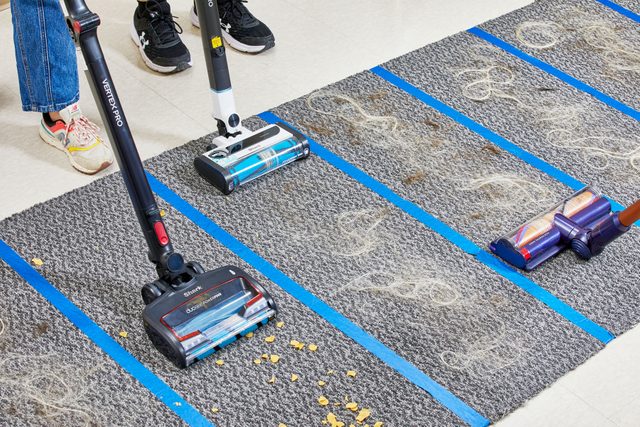
For the Shark vs. Dyson debate, we chose to test five vacuums from Shark’s cordless vacuum lineup: Shark Stratos, Shark Vertex Pro, Shark Cordless Pro, Shark Pet Plus and the Shark Pet Cordless. We spent an estimated 40 hours on these evaluations, including researching, sourcing, intaking and testing the products.
Our evaluations are based on several test categories, including packaging and setup, specs and features, performance, accessories, cleaning and emptying and, finally, value. We rated each category out of five possible points for a maximum total of 30 points overall.
Shark Packaging and Setup
Overall, each of the Shark vacuums we tested came well packaged with its own Quick Start Guide. Note that this is different from the product manuals, which are available online rather than in print. That said, they gave a good overview of how to set up the vacuums and start cleaning.
Assembling all of the vacuums was really intuitive and took less than two minutes each. The lengthiest part of the process was unboxing and familiarizing ourselves with the clips, buttons and functions. From there, we charged up each cordless vacuum. All the Shark vacuums we tested took at least two hours to charge. The Vertex, Pet Plus and Pet Cordless vacuums took closer to three hours to reach full charge.
Shark Specs
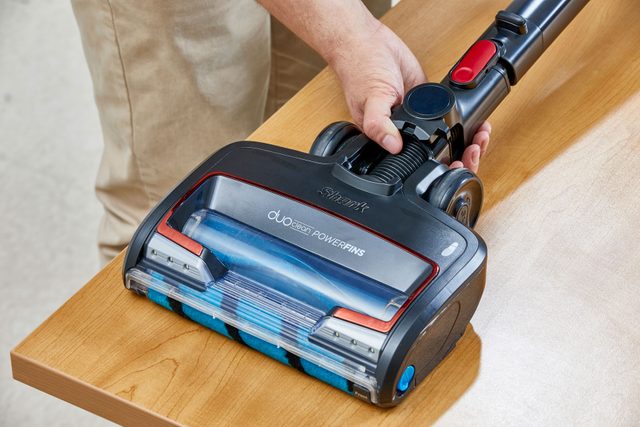
Each Shark vacuum we tested is relatively lightweight. Most average out at just over seven pounds with the battery installed. The Stratos model weighed significantly more at over eight pounds. However, it’s still lightweight enough to glide across the floor with little effort. Considering that cordless vacuums are pretty top-heavy, every little ounce counts!
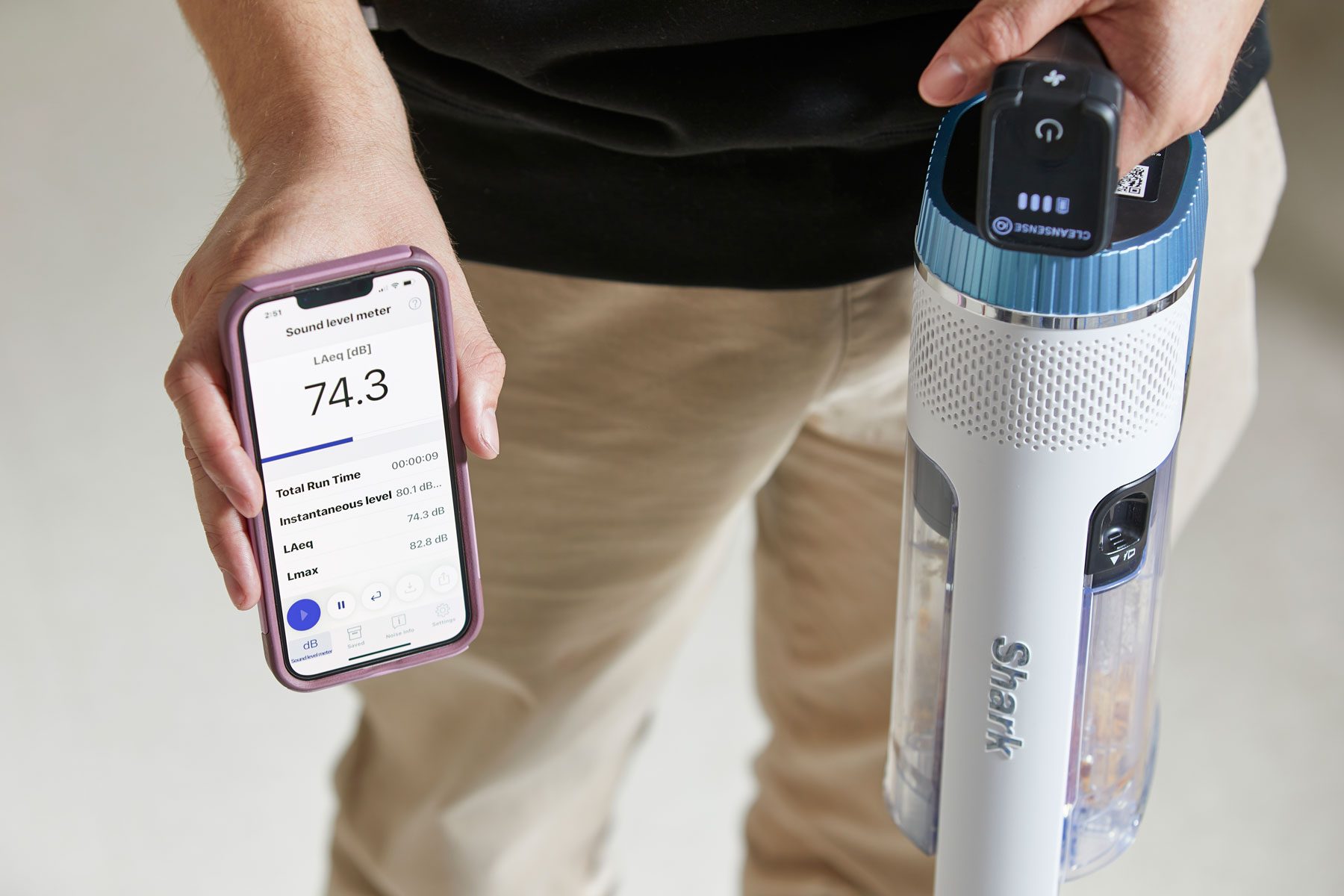
In addition to weight, another important consideration is noise level. At their highest settings, most of the Shark vacuums (aside from the quieter Pet Cordless model) put out about 80 dB of noise. That’s comparable to heavy traffic or a noisy restaurant. On low power, most put out around 75 dB, which is the typical noise level of most vacuums. The outlier is the Pet Cordless model, which topped out at only 73 dB at its highest setting. While none of these options are exactly quiet, we recommend opting for this one if you’re sensitive to noise.
Top Shark Features
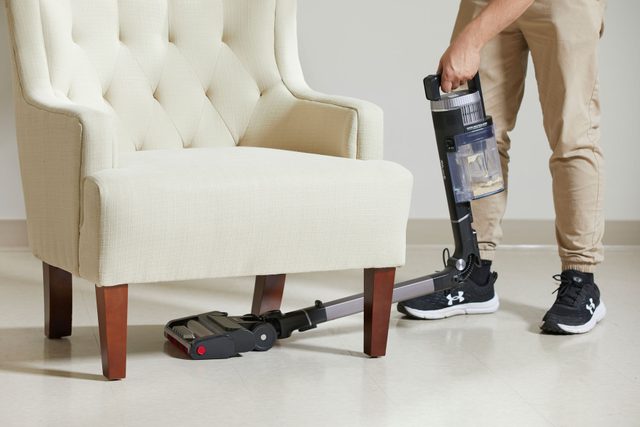
Notable features include a flexible head on the Stratos that makes getting under furniture a breeze. Helpful LED headlights on the Stratos, Pet Plus and Pet Cordless models illuminate dirt and debris in dark spaces like underneath beds and inside closets. Most of the models also offer different modes for a variety of surfaces and soil levels. While the Pet Plus and Pet Cordless models don’t have additional settings, they both boast a pull trigger boost mode for extra dirty areas.
Shark Performance
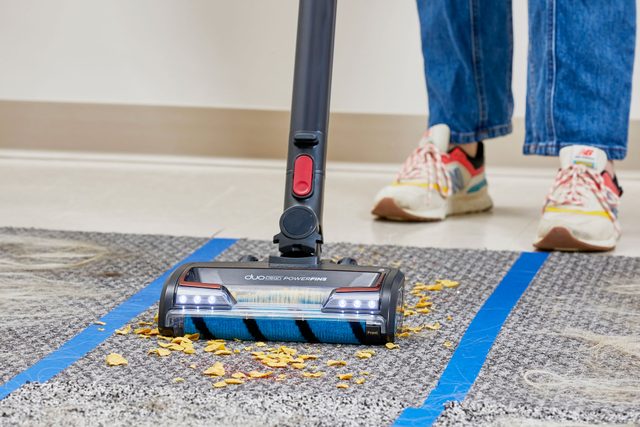
When it comes to performance, we considered battery life, maneuverability, couch clearance, recommended floor type and how effectively each picked up the litter we scattered. We tested several common debris types, including cornflakes, glitter, crumbs and real human hair from a salon—for science, of course! It’s worth noting that each Shark vacuum works on all floor types, though it’s important to use the correct attachment for each surface.
Most of the cordless vacuums lasted around 30 minutes on the carpet setting after a full charge. The Shark Pet Plus and Shark Pet Cordless died much quicker, running for only about 20 minutes before requiring a recharge. That said, the Shark Stratos blew us out of the water with a jaw-dropping 42 minutes of incredible suction power.
In terms of maneuverability, Shark gets high marks across the board. Some models, like the Shark Cordless Pro, offered slight resistance over carpet. That said, each of the vacuums is easy to guide around furniture and glide along the floor. Clearance is similarly impressive, with Shark beating out Dyson for the top two spots. The best clearance ratings belong to the Stratos at just shy of three inches and the Vertex at 3-1/4 inches.
Most of the Sharks performed beautifully on both carpet and tile. However, most also struggled while picking up glitter on carpet, leaving a few specks behind even after a few passes. The two pet vacuums, the Pet Cordless and Pet Plus, performed best on carpet and kitchen rugs. We’d recommend springing for the latter, as the Pet Cordless unfortunately underperformed on the hair tests—not ideal for a vacuum marketed towards pet hair. Those with houses that have a majority of hard surfaces should stick to one of the other models.
The Stratos again impressed us with its performance, simultaneously killing it on both the cornflake and glitter tests while also snatching up a majority of the hair on our carpets. We attribute this to its CleanIQ, which automatically adjusts the vacuum’s suction level based on the amount of debris it detects.
Shark Accessories
While not as tech-forward as Dyson, Shark vacuums boast myriad attachments. Each vacuum includes a crevice tool, but the other attachments vary based on model. The most impressive accessory is the two-in-one multipurpose pet attachment on the Cordless Pro. This tool lifted so much dust and debris off one of our dining table chairs that the fabric turned an even brighter white. While it’s not the best choice for delicate materials, the results are impressive.
We also enjoyed using the anti-allergen brush that comes with both the Pet Plus and Stratos models. Not only does it attach in a snap, but it also easily dusts neglected shelving in mere seconds.
Cleaning and Emptying Shark Vacuums
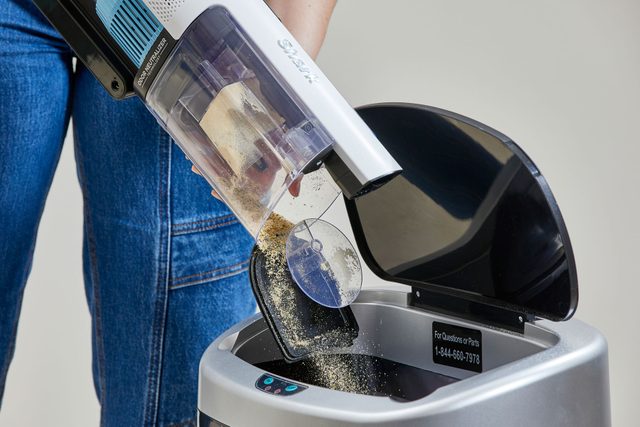
Cleaning a Shark vacuum is incredibly easy. Each of the models we tested cleans up nicely with plain water. Simply run the emptied dust cup under the faucet and dry thoroughly before replacing. The filters are similarly easy to clean using plain running water. Again, ensure that these thoroughly dry prior to replacing.
Our only hang-up regarding the cleaning process is that the filters don’t clean entirely under running water. For the most part, the filters looked grayish after the first use, and no amount of water fixed that. In addition, the dust cup on each vacuum is oriented in a way that it can be easily opened and spilled onto the floor by accident. It’s worth being extra careful not to hit the release button while cleaning!
Shark Value
For the price, you really can’t beat the value of Shark vacuums. Even the Shark Pet Plus and Shark Pet Cordless models, which accumulated the fewest points, still offer pretty decent suction and performance for the lower price point.
The Vertex and the Stratos seemed like markedly higher quality, so although the Cordless Pro performed quite well, we were still surprised to see it was the same price point as the Vertex. In our opinion, those looking for the best performance should consider springing for the slightly costlier Stratos.
If you have a lot of area rugs, the Pet Cordless may be the best budget vacuum for you. The single brush roller has a higher profile that works well with carpet. However, it may not clean hard surfaces as well as other Shark models with the dual roller system.
Pros
- Includes our top performer, the Shark Stratos
- Relatively affordable
- Easy to maneuver
- Tons of attachments
- Performs equally well on carpet and tile
- Decent battery life
- Five-year machine warranty
- Two-year battery warranty
- Lots of different models
Cons
- Easy to accidentally open the dust cup
- No product manual in box
Our Favorite Shark Vacuums
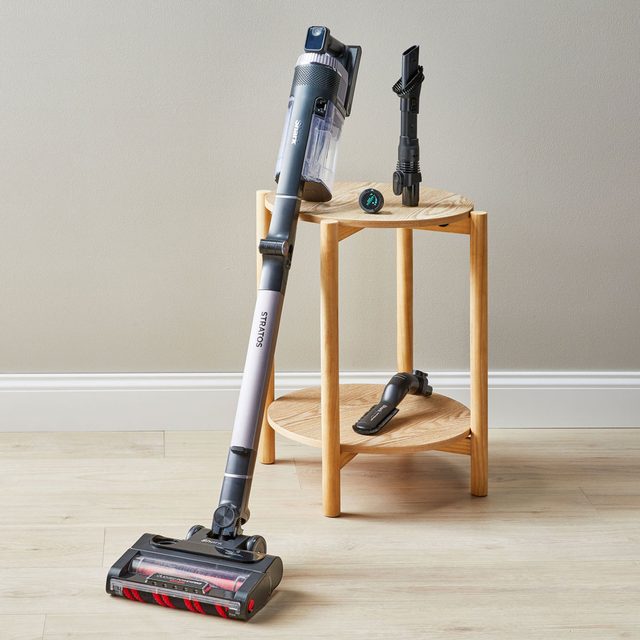
Best Overall
Shark Stratos
This cordless vacuum comes with two handy attachments that tackle dust and allergens on upholstery and shelving, plus myriad features that flawlessly tackle dirt on both tile and carpet.

Best Budget
Shark Cordless Pro
For a budget pick, we prefer the Shark Cordless Pro. Sense IQ automatically adjusts suction to tackle bigger messes, and a lit control panel indicates power level and simplifies switching between hard surface and carpet modes.

Best for Pets
Shark Pet Plus
The Shark Pet Plus makes up for its more modest performance with its fleet of pet-centric features. An upholstery tool de-furs furniture, while an anti-allergen dust brush and crevice tool pull up dander with ease.
How We Tested Dyson Vacuums

In our testing for the the Dyson vs. Shark debate, we tried four different vacuums from Dyson: Dyson Gen5outsize, Dyson V15s Detect Submarine, Dyson v8 and the Dyson v12 Detect Slim.
Like the Shark tests, we evaluated each vacuum based on criteria in the following areas: Packaging and setup, specs and features, performance, accessories, cleaning and emptying and, lastly, value. We conducted the tests (including sourcing, researching and product intake) over the course of 40 hours in our Testing Lab. As with our Shark tests, we rated each category out of 5 possible points, for a maximum total of 30 points overall.
Dyson Packaging and Setup
All Dyson models arrive in a sleek slide-out box sans any branding, offering a sustainable packaging option. Because it opens up from the side, the box works well for accessory storage. It’s also easy to see everything in the box at a glance without digging, unlike the Shark boxes. Each vacuum also comes with an illustrated quick-start guide and a flyer that prompts you to download the Dyson App—more on this later.
Setup is simple, though it takes a bit longer than the Shark vacuums. We are able to assemble most in about a minute. In terms of charge time, Dyson vacuums took a bit longer than the Shark models, ranging from about three hours for the Detect Slim vs. a whopping four hour charge time for the V15s Detect Submarine.
Dyson Specs
In terms of weight, Dyson offers pretty distinct weight differences with each model. The smaller, slimmer v12 Detect Slim and v8 models weigh in at around five pounds, whereas the larger, more robust Gen5outsize and Detect Submarine models are closer to nine pounds. The attachments are also a consideration, with most adding about an additional pound to the total weight of the vacuum.
While the V15s Detect Submarine, v8 and v12 Detect Slim vacuums top out at around 80 db (or the noise level of heavy traffic or a loud restaurant), the Dyson Gen5outsize is a total powerhouse that puts anywhere from 84 dB to 86 dB, depending on the setting. For reference, that’s almost comparable to the sound of an MIG welder on steel. Yeowch—that’s pretty loud!
Dyson Features
Dyson’s features are likely what tips these vacuums into their higher price point. A slick, easy-to-read LCD screen adorns the top of each model, sans the more basic v8. Most impressive is the Gen5outsize menu, which offers stats regarding the current vacuum session including the types and number of particles sucked up.
While insightful, we had difficulty deciphering some of the more nuanced menus. This is definitely one that you’ll want to read the manual for! Luckily, this model does arrive with a rather large instruction booklet.
Other features worth mentioning include a carpet pile height adjuster on the Detect Submarine and Gen5outsize models. The two other models offer a single mode (the v8) and low or max power settings (v12 Detect Slim). All the models are incredibly sleek, minimalistic and feel sturdy and well-made. Aesthetics is definitely an area where Dyson beats out Shark.
Interestingly, the V15s Detect Submarine requires holding down the power button to turn it on—there’s no option for it to be held down on its own. At first, we weren’t fond of having to constantly hold down the button, but we grew to like it—it’s nice to have the button and have so much control over the on and off. This makes it easy to turn on and off in a second if you have to move something or change floor types.
Dyson App
The Dyson App works for all of Dyson’s cordless models, offering a few extras that help with using and maintaining your Dyson vacuum. Instead of actually connecting and controlling aspects of your device, the app is a replacement for the traditional user guide. Each roller head has its own short video guide for usage and the videos change depending on which model and attachments you have.
It bundles information guides, troubleshooting tips, links to support forums, a Digital Assistant and quick access to a customer service rep. All in all, the app isn’t mandatory for your vacuum, but it is an easy way to access any type of information you would want or need for its operation.
The app itself works pretty well. It’s responsive when scrolling, and videos load fast on decent Wi-Fi. There is a Bluetooth connection option, but it seems to be utilized for their other products like air purifiers and headphones. In fact, we’re not even sure it’s possible to connect your vacuum to the app via Bluetooth. Instead, easily connect any vacuums using the device’s serial code.
Dyson Performance

Like the Shark tests, we considered battery life, maneuverability, couch clearance, recommended floor type and how well each picked up the debris. We used the same debris as the Shark test, opting for glitter, cornflakes, crumbs and hair. Battery life for the Dyson vacuums are pretty synonymous with the Shark models minus the Shark Stratos, with all averaging at about 25-30 minutes of runtime per charge.
With such a long charge time, you may assume that Dyson vacuums run for a longer period of time than the Shark models. However, Dyson vacuums averaged at about the same operation time, offering 25-30 minutes of continuous suction before requiring a recharge.
Unfortunately, most of the Dyson vacuums—with the exception of the Gen5outsize—simply pushed around the cornflakes on the vinyl floors. This was rather disappointing, especially given the higher price point. However, all the models performed exceptionally well on low-pile carpets, and save for the two lower-end options, each managed to pick up tons of hair without clogging.
In addition, Dyson’s edge-to-edge feature offers consistent corner-clearing results across all their models. Even the cheapest one still works great in this regard!
Dyson Accessories
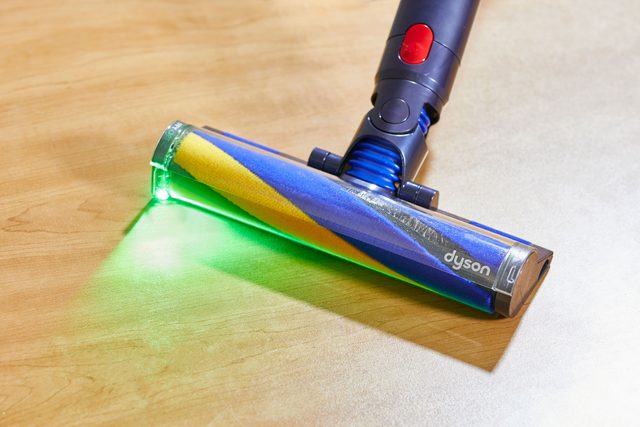
The anti-tangle hair tool on the Gen5outsize and v12 Detect Slim was definitely our favorite attachment. Picking up the hair requires quite a few passes, but we didn’t notice any wrapping up or tangling. It’s super cool to watch the hair work its way through the screw and up the wand. Additionally, on the Gen5outsize model, the “Fluffy Optic” hard-floor cleaner head has a green LED light attached and lights up the ground where you are vacuuming. This really helps show every single speck of dirt on the ground.
That said, there are a few aspects we don’t enjoy. The Gen5outsize requires the crevice tool to convert to a handheld, which makes it very heavy while holding it and bending down due to the oversized dirt cup. The v8’s crevice tool also gave us a few complications. When blocked, the ventilator holes on the side of the crevice tool make the vacuum surge and stop working. This may be a safety feature so it doesn’t start a fire—we can smell it burning when this happens. Yikes!
Similarly, the v12 Detect Slim’s crevice tool only works on the lowest settings. On the highest setting, it behaves similarly to the v8’s crevice tool. It even gives us a pop up warning symbol on the screen when we attempt to use it on high power between cushions.
Dyson Cleaning and Emptying
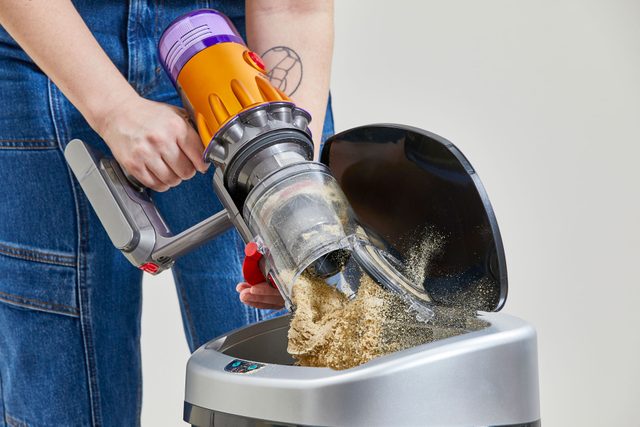
For each model, the rubber portion around the dust cup’s edges really collect a ton of debris. It’s virtually impossible to get fully clean with just a damp rag. That said, everything else wiped clean effortlessly. Those concerned about this should opt for the v12 Detect Slim model. It’s the easiest Dyson dust cup to wipe down because of its orientation.
All of the Dyson filters were relatively simple to rinse, dry and replace. The v8 and Gen5outsize debris chambers were very easy to empty, and there were zero nooks or crannies for crud to collect. On the other hand, both the v12 Detect Slim and the Detect Submarine require a little digging to loosen up the dirt and dust inside, which is rather unpleasant.
Dyson Value
One place where Dyson differs wildly from Shark is in the price point of its vacuums. Whereas the most expensive Shark vacuum we tested topped out at $499, Dyson’s cordless vacuum models start at $299.99 for the most basic vacuum and skyrocket up to $1,049.99 for the Gen5outsize. However, the sleek design and myriad features make up for this discrepancy in price.
The performance of the Gen5outsize was by far the best of all the Dysons. The only downside is the bulk. Plus, it isn’t as easy to maneuver, though it does come with tons of useful attachments. A less costly option is the v8, which is more agile than the Gen5outsize with many of the same attachments. However, it has a smaller dirt cup which requires more frequent emptying. Those in smaller spaces should consider the v12 Detect Slim, which offers a smaller profile that easily maneuvers tight areas.
Pros
- Solid, high-quality materials that last
- Vacuums come with a two-year warranty
- Sleek, minimalistic design
- Tons of useful attachments
- Attractive LED navigation menus
- Well-packaged boxes work well for storage
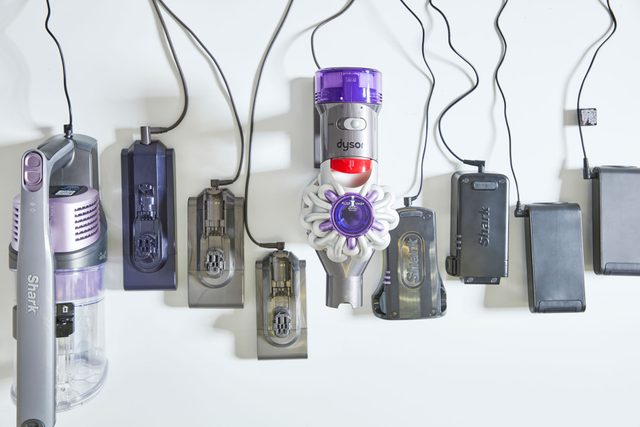
- All vacuums come with a wall-mounted dock
Cons
- Pricier than Shark vacuums
- Crevice attachments gave us some trouble
- Take quite a while to charge
Our Favorite Dyson Vacuums
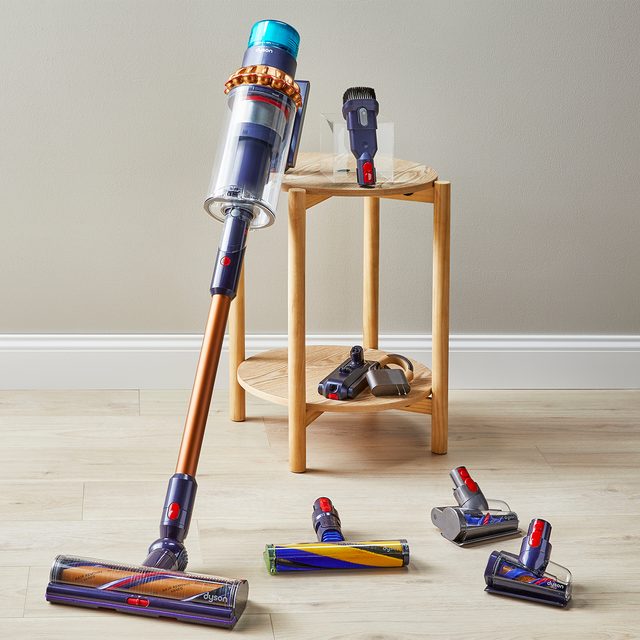
Best Overall
Dyson Gen5outsize
We chose the Dyson Gen5outsize as the overall best Dyson cordless vacuum for its performance, fleet of attachments, sleek LCD screen and enormous dust collection bin.

Best Budget
Dyson v8
The Dyson v8 is the most inexpensive of all the Dyson models we tested. While more basic than the others, it impressed with a lightweight design, uncomplicated settings and stellar performance.

Best for Pets
Dyson Outsize Plus
Tthe Dyson Outsize Plus features a 150% bigger bin and a 25% wider cleaner head than the Dyson V11. This cordless cleaning machine easily snatches up even the biggest pet hair messes.
The Shark vs. Dyson Bottom Line: What Do You Value Most?

So, when it comes to Shark vs. Dyson, which brand comes out on top? Well, it depends on your own expectations and needs. Those looking for a budget pick that offers big bang for your buck and tons of flexible attachments should consider a Shark vacuum. On the other hand, anyone seeking style and substance in a machine that’s built to last for years can’t go wrong with a Dyson.
Regardless of the brand you choose, it’s important to look at the features and attachments to ensure that the vacuum you choose will meet the demands of your household.
Shark vs Dyson FAQ
Is Shark better than Dyson?
Both Shark and Dyson offer cordless vacuums with solid performance. That said, Shark vacuums are typically less pricey than Dyson’s models, and there are a lot more features and attachments to choose from. If you’re looking to tailor your vacuum to your home—taking into consideration flooring and overall use cases—you can’t go wrong with a Shark vacuum.
What is the best performing Shark vacuum?
In our opinion, the top spot goes to the Shark Stratos. It impressed us during our tests with its lightweight design. Rear wheels make it highly maneuverable, as does the flexible bending wand to get under furniture. It stores in an upright position and doesn’t require a wall mount to do so, unlike the Dyson models. With its blend of high suction, impressive attachments and easy navigation, this model boasts high marks across the board and was our favorite vacuum overall.
What Shark vacuum has the most powerful suction?
The Shark Stratos offered some of the best suction power during our Product Testing Team’s evaluations. Only one pass picked up most debris on tile floors, and three passes eliminated most of the glitter and cornflakes on carpet. This was easier to push on the higher-pile carpet than any of the Dyson models because of the large wheels. It also does an excellent job snatching up hair compared to the other models we tested.
Do Shark and Dyson vacuums last long?
Shark vacuums are known to last for up to 10 years before requiring a replacement. However, they need to maintained and properly used to last for this long.
Dyson claims that the average lifespan of their vacuums is around 5 years. That said, some folks use theirs for up to ten years before requiring a replacement, making them an excellent investment.
Should you empty Dyson after every use?
We recommend emptying and cleaning your Dyson after every use in order to preserve the vacuum’s suction and filter integrity.
Why You Should Trust Us
Emily Way is a shopping editor at Reader’s Digest, Family Handyman and Taste of Home as well as a former sales and deals editor. In these roles she has found, reviewed and tested hundreds of home and lifestyle products including kitchenware, cleaning gadgets and subscriptions. Given her experience testing so much home gear, she is well-equipped to compare Shark and Dyson vacuums.
Alexandra Mantella, Content Updates Editor at Taste of Home, updated and contributed research to this piece. She has over five years of experience in product testing, research and commerce writing. Previously, she served as a commerce content update editor at Bob Vila.
The post Shark vs. Dyson: Which Cordless Vacuum Cleaner Brand Is Better [According to Our Tests]? appeared first on Taste of Home.
]]>The post This Is Why Your Can Opener Is Always Rusty appeared first on Taste of Home.
]]>But once you’ve seen how gross your can opener is, you can’t unsee it. I’ll walk you through why it’s rusty and, most importantly, how to clean it.
What causes a rusty can opener?
The main cause of rust on your can opener is water. Here’s a brief chemistry lesson: When iron and oxygen combine in the presence of water, they create iron oxide, or rust. That’s why exposing a can opener to moisture for too long (like sitting in a humid dishwasher) will cause rust. Food particles don’t help either, because all that buildup in the gears and other crevices traps water and causes corrosion. That leads to, yep, more rust.
How do I remove rust from a can opener?
As you probably already know, rust and food shouldn’t mix. The U.S. Department of Agriculture (USDA) says, “Rust is not a food safe material, so it should not be ingested. If you see rust on the surface of a utensil such as a cast-iron skillet or knife, remove all the rust before using it.”
The most efficient way to remove rust from your can opener is with an old cleaning standby: white vinegar. I love using vinegar to clean things like stained baking sheets and my wood cutting board. The acidity works wonders while also being food-safe.
Here’s how to clean a rusty can opener with vinegar:
- Fill a Mason jar with enough white vinegar to submerge the rusty part of your can opener (often only the gears are rusty).
- Place the can opener in the vinegar and soak for about five minutes. Extend the time if your can opener is super dirty.
- Take the can opener out of the vinegar and scrub with a small brush dipped in the vinegar. I like to keep an old toothbrush under the kitchen sink for jobs like this.
- Continue scrubbing with vinegar and rinsing until the can opener is clean. Dry thoroughly with a cloth.
How can I prevent rust from forming on a can opener?
Once your can opener is sparkling and rust-free, keep it that way with proper maintenance. Clean your can opener after every use, but don’t put it in the dishwasher—the humidity and steam will lead to more rust. Instead, give it a quick rinse under hot water, and scrub with a brush and a little dish soap to clean all the hard-to-reach areas. Once it’s clean, the most important step is drying. Air-drying is not enough. Dry the can opener completely with a soft cloth before storing. Remember, moisture equals rust!
The post This Is Why Your Can Opener Is Always Rusty appeared first on Taste of Home.
]]>The post This Is the Dangerous Mistake People Make When Doing Dishes appeared first on Taste of Home.
]]>The same goes for your kitchen towels. You might spread germs with your dish towels every time you clean up.
What makes dish towels so dirty?
The abosrbency that makes kitchen towels effective is the same factor that makes them hazardous, holding in all the dampness and creating conditions for harmful bacteria to spread. If you use the same towel to dry your hands that you use to dry your dishes, you’re only compounding the issue, increasing the likelihood of fostering salmonella, E. coli and staph.
This 2015 study from Kansas State University observed subjects moving through the kitchen and found that towels were “the most contaminated of all the contact surfaces tested.” When we clean up the kitchen, those towels pick up contaminants. Then, when we wash our hands and dry them on the same towel, we transfer those contaminants back onto ourselves. The reverse is also true, where our nasty hands (and fingernails!) transfer gunk to our clean dishes via the towel used to dry them. Either way, not great.
How do I keep separate towels straight?

The issue of cross-contamination has an easy fix: Dedicate one towel in the kitchen to hands, one to dishes and one to countertops. America’s Test Kitchen recommends a simple color-coding system so that everyone in the household knows which towel is for which purpose.
Even once everyone in the house learns to keep the different towels straight, that alone won’t keep your kitchen sanitary. You’ll also need to wash all the towels frequently enough to combat the spread of germs.
How do I clean dish towels?
Wash your dish towels and hand towels every day or every few days, depending on how much cooking you do and how much foot traffic your kitchen sees. Towels should be washed in hot water to kill any bacteria lurking in the fabric. Remove the towels from the washing machine promptly and send them through the dryer. Make sure they’re completely dry when removed because if they’re still damp, they’re more likely to foster bacteria. After using a towel while cooking, hang it somewhere that air can circulate and dry it fully. Folding it up or leaving it crumpled on the counter will keep it damp and more hazardous.
The Kansas State University study also noted another troubling kitchen habit: using our phones while cooking. Since our phones go with us just about everywhere, they, too, should be sanitized before using them to consult dinner recipes.
The post This Is the Dangerous Mistake People Make When Doing Dishes appeared first on Taste of Home.
]]>The post This Is What Professional Organizers Store in Hard-to-Reach Cabinets appeared first on Taste of Home.
]]>However, high kitchen cabinets don’t have to be wasted space. “The cabinet above the refrigerator is often overlooked or used as a catch-all for miscellaneous items, but it can become a functional storage space,” says professional organizer Carol Appelbaum of Luxury Pro Organizer.
Here’s exactly what professional organizers recommend storing in the cabinet over your refrigerator and how to organize kitchen cabinets for maximum efficiency.
What to Store in High Kitchen Cabinets

Seasonal decor
Over-the-fridge cabinets are ideal for storing items that you don’t use often, such as seasonal decor. “One of my favorite uses for this cabinet is seasonal or holiday-specific items, such as holiday dishes, serving pieces and festive cloth napkins,” says Appelbaum. “Since these items are only used occasionally, they won’t clutter your everyday storage, but they’ll still be within reach when you need them.”
Oversized serving platters
If you struggle to find a home for big serving dishes, the over-the-fridge cabinet can often accommodate them. “The cabinet above the fridge is likely at least 18 inches tall, if not closer to 24 inches. Combine that with the fridge depth—usually 24 inches deep—and this is a perfect place for large platters,” says professional organizer Courtney Cummings of The Stylish Organizer. “Fully maximize your space using vertical dividers to section off each piece and easily slide platters in and out.”
Lesser-used cookbooks
I’m certainly guilty of holding onto more cookbooks than I need, and high cabinets are a good place to store cookbooks that you don’t reach for every day. “Store extra cookbooks above your fridge when you run out of display room on your counter,” says Cummings. “Store them vertically to maximize your space and use a bookend or small appliance to keep them upright.”
Lightweight items
It’s tempting to stash a slow cooker or Dutch oven above your fridge, but this overhead location isn’t ideal for heavy objects. “Lifting and lowering heavy items from a top shelf can be difficult and even dangerous,” says Appelbaum.
“Consider storing lighter items rather than bulky, heavy cookware or appliances,” she says. “If using storage containers, make sure they’re clearly labeled in large font so you can identify them from below without having to pull them down.” Some lightweight items you might consider stashing above your fridge include extra linens, party supplies, or bulk items like paper towels.
How to Organize High Kitchen Cabinets
If you want to prevent high cabinets from becoming a jumbled mess, be meticulous about what you put up there. “When organizing this space, make sure everything can be seen easily from below,” recommends Appelbaum. “Storing more than one item deep is not efficient because you will have to remove multiple items just to reach something in the back.”
You may want to invest in a few storage essentials. “To maximize vertical space, consider using small stacking containers or a cabinet riser. These will help keep items neatly organized where you can see them,” says Appelbaum.
It’s a good idea to periodically assess what you have stored in high kitchen cabinets and remove items that are collecting dust. Professional organizers recommend getting rid of kitchen items you haven’t used in a year (or more). This will help keep your cabinets tidy and reduce kitchen clutter.
The post This Is What Professional Organizers Store in Hard-to-Reach Cabinets appeared first on Taste of Home.
]]>The post 15 Items in Your Kitchen That Professional Organizers Would Throw Out appeared first on Taste of Home.
]]>
Expired food and spices
Chances are, there’s expired food lurking in your pantry. There are plenty of foods you can keep past their expiration dates, but stale, old and long-expired things should be one of the first things to go. “I recommend you quickly scan your pantry for expired food and spices once a quarter,” says Cummings. “Not only will this free up space on your shelves, but it will also ensure that your family is eating meals made with the freshest ingredients.”

Novelty appliances
There are so many cool appliances out there, like ice cream makers, slushie machines and novelty waffle makers. They’re all fun to use, but if you have some that you don’t use regularly (or at all), they may not be worth keeping in your kitchen. “Specialized gadgets like egg slicers and avocado pitters may seem innovative in the store but rarely justify their drawer space,” says Palmer.

Duplicate tools
Do you have multiple can openers or apple slicers cluttering kitchen drawers? You can save a lot of space by getting rid of extra tools and utensils. “I recommend gathering all duplicate gadgets into one place, likely on the counter or table,” says Appelbaum. “Then, critically assess what you really use and need. A couple of good knives, one potato peeler, a grater, a colander, a couple of spatulas and cooktop spoons are sufficient.”

Leftover entertaining supplies
Everyone loves a good theme party, but if you still have napkins hanging around from your 40th birthday or cocktails plates from casino night, it might be time to discard or donate them. Alternatively, you can make an effort to use them up, but make sure they don’t end up in the back of your kitchen cabinets again.

That overflowing stash of bags
We’re all guilty of keeping stashes of plastic or paper grocery bags—just in case!—but how many do you really need? If your collection has gotten out of control, organizers recommend getting rid of the majority of them. “While excess paper grocery bags can be useful for some purposes, large stashes of paper bags can attract pests,” says Appelbaum.

Foods you don’t actually like
Remember when you swore you were going to switch to cauliflower rice—only to discover you don’t like the taste at all? That head of cauliflower might still be hiding in the back of your refrigerator, and there’s really no need to keep it around. Palmer recommends asking yourself, “Does this item reflect your cooking style or represent who you wish you were in the kitchen?”

Tools that collect dust
“If you haven’t touched your garlic press in a year, or if that juicer is still in the box from last Christmas, it is time for them both to move out,” says Cummings. “Be realistic with your culinary needs and donate anything that you don’t use on a regular basis.” A good rule of thumb is to get rid of anything you haven’t used in more than a year.

Food that’s been open for a while
Half-eaten containers of food might still technically be good, but they’re probably stale and unlikely to actually get eaten. “Opened food like chips, cereals, crackers and other packaged goods can go stale quickly once exposed to air,” says Appelbaum. “If they’ve been sitting a while and have lost their freshness, it’s time to let them go.”

Mismatched food storage containers
A good set of food storage containers is a must for your kitchen, but that doesn’t mean you have to keep the stained, broken or mismatched pieces in your cupboard. “If you open a cabinet and all of your food storage containers fall out on you, it is definitely time to assess what you have,” says Cummings. “Discard any old containers with stains or scratches. It is also absolutely time to get rid of any bins without matching lids, or any extra lids that don’t have a mate.”

Chipped dishes and glassware
That mug with half a handle that no one ever uses? Professional organizers encourage you to throw it out. “Unless you are really handy with superglue or are saving something for sentimental purposes, get rid of any broken or chipped dishes and cups,” says Cummings.

Damaged pots and pans
The same holds true for damaged cookware, whether it’s a baking sheet with food burnt onto the edges or a nonstick pan with scratches in the finish. These items are just taking up space, and if you can’t fix them (or don’t have time to), it’s time to get them out of your kitchen.

Piles of paper
If you keep a collection of product manuals in your kitchen, it’s a good idea to go through them periodically. You might find that you’re holding onto manuals for appliances that you haven’t owned in years. The same goes for coupons, takeout menus and junk mail.

All those extra water bottles
It’s the age-old question: How many reusable water bottles do you actually need? Chances are that you reach for your favorite one or two again and again, so don’t be afraid to donate the extras that have been shoved to the back of the shelf. The same goes for travel mugs.

Rancid oils and nuts
“Be sure to open the oils, peanut butter and other nut butters to see if they smell rancid,” recommends Appelbaum. “If they have an unusual smell, it’s time to replace them.” Nuts are one of the baking ingredients you can store in the freezer to prevent them from going bad.

Overly bulky appliances
If you have a smaller kitchen and limited storage space, consider getting rid of oversized appliances that you don’t use frequently. “Does this item’s usefulness justify its storage footprint? A bulky appliance used weekly might be worth keeping, while one used annually might not deserve prime kitchen real estate,” says Palmer. Some common culprits include bread makers, specialty blenders and juicers.
The post 15 Items in Your Kitchen That Professional Organizers Would Throw Out appeared first on Taste of Home.
]]>The post 4 Secrets for a Sparkling Kitchen from Drew and Jonathan Scott appeared first on Taste of Home.
]]>The brothers are experts in home renovation and real estate, so they know the value of a clean and sparkling home. Whether you’re staging your home to sell, or simply tackling a neglected kitchen, Drew and Jonathan’s tips are easily achievable. We gathered up a few spot-on cleaning and organization recommendations that will make your life easier.
Use one shelf in the refrigerator for leftovers

In this TikTok, Jonathan gives a tour of how he and wife Zooey Deschanel keep their refrigerator organized. The most genius tip he shares is designating one shelf as the leftover shelf. No need to search the whole fridge for that last piece of pizza, because it will be on the leftover shelf! Corralling your leftovers in one area also prevents them from being shoved to the back of the fridge where they get lost, forgotten and moldy.
Invest in drawer organizers

If you’ve done any kind of home organizing, you’ve come across drawer organizers in some shape or form. This Drew and Jonathan TikTok shows how simple drawer dividers can completely transform your unruly kitchen junk drawer. Create individual sections for different items, like Post-It notes, pens and tape. When it’s time to purge and reorganize, simply rearrange the contents to fit your needs.
Organize cabinets like a store

Jonathan Scott shows off his laundry room cabinets in this TikTok, and recommends organizing them like store shelves. Most of us aren’t lucky enough to have such a spacious laundry room, but you can apply his tip to any storage space, like a linen closet or pantry.
Everything has a place and is clearly labeled. Wire baskets (here’s a similar product) inside the cabinets help keep the different products separated and tidy. You can easily see what you have and when it’s time to restock.
This is why the Property Brothers prefer cabinets to open shelving.
Choose dependable cleaning products

Drew and Jonathan have several cleaning products that they use again and again. Your cleaning closet, caddy or cabinet should be stocked with dependable workhorses that get the job done. In this @drewandjonathan reel, they put The Pink Stuff to the test in the kitchen. The viral cleaning paste is great at removing grime from the sink, the stovetop and even inside the oven. Some of Drew and Jonathan’s other go-to products include the Mr. Clean Magic Eraser and Mrs. Meyer’s Multi Surface Spray.
Realistically, a home visit and renovation from the Property Brothers only exists in our dreams. But at least we can incorporate their cleaning advice in our kitchens! Follow the brothers’ expertise to keep your house clean, tidy and fresh. And remember, Drew and Jonathan always make cleaning fun, so crank up the music while you work!
The post 4 Secrets for a Sparkling Kitchen from Drew and Jonathan Scott appeared first on Taste of Home.
]]>The post The 8 Best Pots and Pans Organizers of 2025 appeared first on Taste of Home.
]]>
Best Overall Pots and Pans Organizer
Mudeela Three-in-One Pan Organizer
Pros:
- Three setup options: vertical, horizontal and side-to-side
- Silicone layers prevent sliding
- Affordable price point
- Easy to assemble
Cons:
- Not ideal for heavy cookware
This three-in-one pan organizer is customizable to your space, offering three different setup options and eight adjustable shelves. Since the wire shelves are adjustable, everything from large simmer pots to 8-inch frying pans fits with ease. With over 9,000 five-star ratings, there’s no doubt the Mudeela pots and pans organizer is a game-changing Amazon find. No more fumbling around on your hands and knees to find your favorite pan!

Best Budget Pots and Pans Organizer
Simple Houseware Store Pan and Pot Lid Organizer Rack
Pros:
- Affordable price point
- Holds five items
- Two setup options: vertical or horizontal
Cons:
- Doesn't work as well with pots
- Not ideal for heavy cookware
Kitchen storage organizers don’t have to break the bank. This wallet-friendly pan organizer is a steal and offers two storage options. Lay the rack vertically or horizontally—it holds up to five of your best pots and pans. Bonus: It doubles as a way to organize baking supplies, as it holds muffin tins, baking sheets and cutting boards.

Best Pull-Out Pots and Pans Organizer
Lynk Professional Sliding Shelf Organizer
Pros:
- Pulls out of the cabinet with ease
- Multiple size options
- Versatile storage uses
- Ideal for heavy cookware
Cons:
- Requires more time to assemble
Say goodbye to digging around on your hands and knees to find the Dutch oven at the back of your cabinet. This smooth sliding shelf pulls out with ease, making it easier to locate the KitchenAid stand mixer and attachments, pressure cooker and, of course, your favorite pots and pans. Nearly 7,500 five-star ratings can’t stop talking about how it eliminates “dead” cabinet space. BRB, we’re adding one to our cart immediately.

Best Lid Organizer
Simple Houseware Cabinet Door Lid Organizer
Pros:
- Adds storage to cabinet doors
- Ideal for small spaces
- Easy to assemble
- Holds six lids total
Cons:
- Not all cabinet doors can hold the weight
Here’s a pantry organization tip you’ll wish you knew sooner: Use interior cabinet doors for a lid organizer. It comes with two racks for storing three lids each. Just screw it into the cabinet door and start organizing! You’ll thank yourself for not having to deal with lids toppling over their pans in the cabinet (yet again).

Best Pan Organizer
Better Things Home Store Expandable Pan Organizer
Pros:
- Adjustable length
- Holds eight items
- Affordable price point
- Multiple sizes available
Cons:
- Weight should be distributed evenly
If your cabinets don’t have the depth for sliding units, you’re not out of luck. This expandable pan organizer offers convenient storage for cabinets both small and deep. At just over 1-foot long, it’s adjustable up to 25.4 inches to maximize space even in deep cabinets. It comes with eight removable dividers to hold up to eight pans, pots or lids at a time. And if you need more dividers, 10- and 14-rack versions are also available. This pots and pans organizer will turn you into a pro in no time!

Best Cast-Iron Pots and Pans Organizer
Five-Tier Pan Organizer
Pros:
- 50-pound capacity ideal for heavy cookware
- Holds five items
- Versatile storage uses
- Affordable price point
Cons:
- Length isn't adjustable compared to some options
Cast iron, meet your match. With a 50-pound capacity, this five-tier organizer is strong enough to hold your heaviest pans, including cast-iron and enamel cookware, without buckling or tipping over. It’s ideal for most cabinet sizes, and holds up to five of your best cast-iron skillets and cookware pieces.

Best Splurge Pots and Pans Organizer
Rev-A-Shelf Two-Tier Wire Pull Out Kitchen Cabinet
Pros:
- Two-tier pull-out shelf system
- Features a heavy-duty frame
- Holds up to 14 items
- Has a 100-pound capacity
Cons:
- On the pricey side
- Requires more time to assemble
If you’re reorganizing your kitchen, dedicate a cabinet to Rev-A-Shelf’s pots and pans organizer. The pullout organizing system is available in two sizes, 12 inches and 21 inches, and holds up to 100 pounds of pots, pans and lids in a two-tiered, sliding unit. It’s certainly on the pricey side, but it’s worth it for anyone who’s dreaming of a pull-out organization system for all their best cookware (aka us).

Best Mounted Pots and Pans Organizer
KES Mounted Kitchen Pot Rack
Pros:
- Doesn't require cabinet space
- Holds 55 pounds
- S-hooks offer versatile storage uses
- Affordable price point
Cons:
- Requires more time to assemble
When cabinets aren’t much of an option, turn to this shelving unit. The sturdy 2.5-foot-long organizer comes complete with two shelves, a hanging bar and 12 removable S-hooks. This means there’s plenty of room for pots, pans, lids and utensils. Plus, the S-hooks double as an organizer for essential kitchen tools. Pro tip: It adds visual appeal since all your pretty cookware is on display. Now that’s our kind of pots and pan organizer.
What to Look for When Buying a Pots and Pans Organizer
It’s important to know what pots and pans need organizing before picking out your dream product. Then, think about where you’ll keep the organizer. Do you have a wide cabinet to store it? Or will you need a mounted solution? Measure the dimensions of the space before choosing your pots and pans organizer.
How We Found the Best Pots and Pans Organizers
As shopping experts, our only job is to help you find a winning product. We start with the research and reporting basics—what products are made of, what they look like and how much they cost—to ensure that we’re only recommending the buys that are worth your time and money. Then, we research the features that speak to the product’s quality, taking advice from industry insiders and subject matter experts on what makes a product a smart value (or worthy of a splurge). Finally, we do the work of combing through user reviews to see how real people interact with the product, and if it stands up to the test.
FAQs
What can yo u use to organize pots and pans?
Before deciding on your organization system, you must figure out where you’ll be storing your pots and pans. That’s most likely on classic shelves or in a pull-out drawer, and there are systems to accommodate each one. Some organizers are specifically for lids or pans while others work for pots, pans and their lids. The good news is that there’s a variety out there, so you can find exactly what you need.
What type of cabinet is best for pots and pans?
Deep cabinets or drawers are your best bet for storing pots and pans. These pieces are typically large, bulky and oddly shaped, so having open space to work with makes the organization process simpler. A cabinet with a built-in lazy Susan could also be ideal, as you don’t have to stack so many pots and pans on top of one another.
Where should heavy pots and pans be stored?
That heavy cast-iron pan? Put it in a low cabinet or drawer. The last thing you want is to be reaching overhead and accidentally dropping it on yourself, your pet or the floor.
How to store pots and pans in a small space?
When cabinet and drawer space is limited, try turning to other areas of the kitchen for storage. You could use a hanging rack over the stove or against the wall. Bonus: You’ll always have the pot or pan you need within arm’s reach!
The post The 8 Best Pots and Pans Organizers of 2025 appeared first on Taste of Home.
]]>The post 12 Surprising Things That Are Not Dishwasher Safe appeared first on Taste of Home.
]]>Here’s a quick rundown of some pieces you really shouldn’t put in the dishwasher (and how to clean them instead).
What is not dishwasher safe?
1. Stanley cups
We love staying hydrated, so our Stanley cups get heavy use. But there’s good news and bad news about washing Stanleys. The bad: Stanley cups shouldn’t go in the dishwasher. The heat can damage the finish and—worse—compromise the seal, spoiling the cup’s insulating properties. (Technically, the manual asserts that they can go in the dishwasher, but it’s not ideal.)
The good news, however, is that if you’re using your Stanley cup for water, you don’t have to wash it every day. Just disassemble and give it a quick rinse, then give it a full soap-and-water wash once a week. Use hot water and not too much soap (that’s a surprisingly common dishwashing mistake).
2. Hydro Flask water bottles
You’ll find the same deal with Hydro Flask bottles—the dishwasher puts lots of pressure on the insulated chamber. Older models aren’t dishwasher safe, and while newer bottles technically can go in the dishwasher, it’s not the ideal cleaning method for an insulated cup.
For daily and weekly care, wash your water bottle in hot, soapy water. When it’s time to deep-clean your water bottle (say, if you happen to have forgotten to clean it for a while—we’ve all been there!), fill the bottle with one part white vinegar and five parts water. Let soak overnight, then wash with soapy water, rinse and dry.
3. Cast-iron pans
We love cooking with cast iron, but it does call for special cleanup. Plain cast iron is an uncoated metal, which makes it prone to rust. Putting cast iron in the dishwasher can seriously tarnish the metal. Luckily, it’s easy to clean cast iron. Just wash it in a bit of soapy water, using a gentle cloth or scrubber to dislodge stuck-on particles. Dry it off right away, and rub on a bit of canola oil or other neutral oil to preserve the cooking surface.
4. Wooden kitchen utensils
If you’re trying to divest potentially toxic plastic utensils, wooden tools are a great alternative. They’re soft enough to use on nonstick cookware but sturdy enough to scrape the caramelized coating from a pan. To preserve them, don’t put them in the dishwasher. The intense heat and moisture can make the wood split, warp or crack. Once again, washing in warm, soapy water is the way to go.
5. Sharp knives
We get it, the dishwasher has a handy top rack that’s just right for stowing knives. And a good quality set of knives is sharp and durable—surely they can take it?
Not quite! The long, hot dishwasher cycle wears out knife handles and can blunt the blades, making them less effective and less safe. Another concern is that sharp knives also do damage to the dishwasher rack, potentially poking through the plastic coating.
6. Le Creuset
One of our favorite kitchen tools, Le Creuset cookware is so durable and well-crafted that it can last a lifetime—or even become an heirloom. In order to help it last, it’s important to care for the pots and pans properly. The enameled cast iron is naturally nonstick, making it easy to cook and clean. The simplest cleaning is the best. If the pot is very dirty, soak it for half an hour, then wash with soap and water. Some pots can go into the dishwasher (most pieces without plastic or wooden knobs), but it can dull the enamel, making the pot a bit less pretty.
7. HexClad

Our favorite HexClad pieces are durable, easy to use and deliver top-notch results. HexClad is nonstick, but it relies on a “seasoning” of coated-on oil to achieve that slick, gliding surface. Sticking the pots and pans into the dishwasher can spoil the seasoning. Worse, the heat can dull the pans, and some detergents can cause etchings or pockmarks on the metal. To keep those pricey pots looking (and cooking) good, wash them with soapy water.
8. Tupperware
It’s tough to beat the performance of old-school Tupperware. But beware: Older Tupperware containers are made from plastic that isn’t dishwasher safe. The high heat of the dishwasher (even the top rack) can warp or misshape the plastic.
9. Nonstick cookware
Nonstick cookware often boasts that it’s dishwasher-safe, likely to lure cooks into the convenience. Unfortunately, as with most types of cookware, nonstick pans don’t thrive in the humid dishwasher, which is rough on nonstick coating.
10. Copper pots and pans
What’s prettier than a shelf full of gleaming copper pots? Expensive, high-quality copper conducts heat like nobody’s business—but it is finicky. Copper definitely doesn’t belong in the dishwasher, which will discolor the copper and can even make it pit. Instead, wash the cookware with soapy water. The same goes for your copper Moscow mule mugs.
11. China
Whether you collect vintage china or received a brand new set for your wedding, it’s best to keep it out of the dishwasher. Most china is made of porcelain, which is actually quite durable. However, the designs painted on the china may wear away in the dishwasher. And any china with metallic accents, such as gold around the rim, should never go in the dishwasher or the microwave.
12. Ceramics

Found a funky handmade mug at an art fair? Do you collect vintage ceramic bowls? Best to keep them out of the dishwasher. Even though it’s chunky, rustic and sturdy-looking, ceramics can crack in the dishwasher, and will dull with repeated exposure.
The post 12 Surprising Things That Are Not Dishwasher Safe appeared first on Taste of Home.
]]>The post This Is the One Thing Everyone Forgets to Clean After Dinner appeared first on Taste of Home.
]]>Now that I have a kitchen of my own, I find myself washing and wiping every surface in sight. The pots, pans, dishes and countertops get regular treatment, but I recently discovered another kitchen item I should pay attention to. Turns out salt and pepper shakers are much dirtier than I thought.
Why are salt and pepper shakers so dirty?

They’re likely two of the most used items in your kitchen. Think about the last time you made a recipe that didn’t include salt somewhere—not very common. They’re constantly being touched, not only by you, but also your family, friends and anyone else you have over for a holiday gathering. You use them before and after handling meat, veggies and other seasonings. If they’re next to your stove, it’s also likely oil particles have made their way onto the surface, which makes it much easier for dust, germs and other grime to stick. Pepper shakers specifically harbor upwards of 11,600 bacteria on average, according to an ABC News study.
Do you remember the last time you really cleaned your salt and pepper shakers? If you can’t, don’t worry. Luckily, we’ve got all the tips and tricks you need to clean kitchen items from counter to counter.
How do I clean salt and pepper shakers?
Wipe down the exteriors of your salt and pepper shakers at least once a week with a damp cloth, more often if you keep them near the stove like I do. When your shakers empty out, give them a thorough run through the dishwasher (if they’re dishwasher safe) or hand wash with soapy water. Now you’re one step closer to a cleaner kitchen.
The post This Is the One Thing Everyone Forgets to Clean After Dinner appeared first on Taste of Home.
]]>The post You’re Using Your Self-Cleaning Oven the Wrong Way—Here’s How appeared first on Taste of Home.
]]>Resist the instinct to self-clean, at least for now. Relying on self-cleaning can be harmful, causing mechanical issues or just plain wearing the oven out. Here are some common mistakes people make with self-cleaning ovens, along with a better way to keep this essential appliance nice and clean.
Using the Self-Cleaning Feature Too Frequently
The self-cleaning feature takes a toll on your oven’s inner workings. A self-cleaning cycle heats the oven to a tremendously high temperature, turning even the most stubborn bits of food residue into ash. The trouble is that modern stoves have hidden heating elements inside the ceiling of the oven and/or under the oven floor. These are safer for baking than exposed elements but trickier to vent. When temperatures rise above 500° or 600°F, the incredible heat can make fuses pop and control panels burn out. Yikes!
What to do instead:
Experts suggest using the self-cleaning feature just once or twice a year. You can also consider shutting off the self-cleaning cycle after one hour rather than deploying the full-length cycle, which can run closer to four hours.
Using Self-Cleaning Instead of Regular Cleaning
If you use your oven often, self-cleaning once or twice a year won’t keep it clean for long. The grease from baking bacon, overspill from casseroles and pizzas that drip cheese onto the floor add up pretty quickly. But don’t rush to press the self-clean button. The self-cleaning cycle isn’t the only way to clean an oven—or even the best way.
What to do instead:
It’s easy to clean an oven. For starters, wipe out the interior of a cool oven with a soapy dishcloth or sponge. Regular and simple upkeep prevents crumbs and grease from building up and getting baked onto the walls.
If the interior looks extra grimy, steam clean the oven. Put a pot of water with the juice of a lemon or two into the oven and bake until the oven walls are steamy. Turn off the oven, leaving the pot in place. Once it’s cool, wipe down the walls, floor and window with a sponge. The steam will soften up the caked-on gunk, making it easy to remove. Plus, cleaning with lemon makes a nice-smelling oven.
Using Harsh Commercial Cleaning Agents
You can find many commercial oven cleaners at the store, so it seems like an obvious choice for scrubbing out your oven…right? Not always. Commercial oven cleaners can cause the self-cleaning feature to be less effective—kind of self-defeating.
What to do instead:
Gentle cleaners are extremely effective and they’re nontoxic, which is ideal for cleaning a device you use for cooking! One of our favorite natural cleaners is white vinegar diluted in water. You can also use plain dish soap dissolved in warm water. You can even clean a greasy oven window with a simple paste made from baking soda and water.
To clean oven racks, remove them and scrub them in the sink (or even in the tub, if you need the space) with dish soap or baking soda paste. Use a scrub brush on tough spots, or let them soak, allowing stains to soften.
It may sound like a big effort to clean the oven with elbow grease rather than by pressing a button. That’s why we suggest regularly wiping down the oven, preventing a big mess from taking hold!
The post You’re Using Your Self-Cleaning Oven the Wrong Way—Here’s How appeared first on Taste of Home.
]]>The post TikTok Users Just Discovered the Toaster Crumb Tray appeared first on Taste of Home.
]]>Where is the crumb tray?

TikTok creator @kacie_thebigcleanco posted a video on TikTok featuring the crumb tray. In the video, her voiceover says, “There are cleaning ‘hacks’ going around the internet that are not really hacks at all. They make it harder. I’m a professional cleaner, and this week I was sent one: ‘Clean your toaster with a hair dryer!'”
This refers to an odd piece of cleaning advice that makes its way around the internet every few years. It says that blowing a hair dryer into the toaster slots will push loose food down into the crumb tray for easy removal. But, as Kacie says, “just tip it in the bin.”
She wipes crumbs off the top of the toaster, removes the crumb tray from down below and empties it in the trash before replacing it. Kacie also gives the entire toaster a quick shake over the garbage to dislodge the remaining crumbs—no hair dryer required.
Ironically, her video intended to show how easy cleaning a toaster can be, sans elaborate “hacks.” But that’s not what viewers took from it.
“Wait? Toasters have trays?” wrote one commenter. “There’s a TRAY?!?!?!?!!” wrote another. “Do all toasters have that?” asked yet another.
Is there a hidden crumb tray on every toaster?
The Mirror is even riffing on this TikTok video, using it as the jumping-off point to discuss the “hidden” toaster compartment that’s “blowing people’s minds.” This compartment isn’t a secret, though. It’s always been there, and it slides out easily from underneath the slots so you can tidily remove the crumbs.
To say that it’s “always” been there isn’t even that much of a stretch. The automatic pop-up toaster as we know it came about in the 1920s, and by 1939, General Electric had filed a patent for the toaster’s slide-out crumb tray.
If you’ve never noticed the tray, that’s probably because it’s located on the short end opposite from the side that has the levers and buttons. But it should indeed be there—it’s too effective not to build into virtually every model. Even my $12 generic toaster from Target has this simple and effective feature.
How often do you empty the crumb tray?
This depends entirely on how often you use your toaster, and what you toast in there. If you’re eating everything bagels on the daily, check it about once a week. If you use your toaster sporadically like me, check the tray every half-dozen uses and be sure to dump out any crumbs you find. No need to do anything more extensive than that for regular maintenance, but do clean out your crumb tray, or the crumbs will build up and lead to acrid, burnt bits that risk catching on fire in the toaster.
We live in a (literally) golden age of toast innovation. As long as you treat your appliance right, you should be able to enjoy avocado toast, panzanella salads and open-faced tuna melts without incident.
The post TikTok Users Just Discovered the Toaster Crumb Tray appeared first on Taste of Home.
]]>The post 5 Joanna Gaines Kitchen Ideas to Keep Your Space Organized appeared first on Taste of Home.
]]>Here are some of our favorite Joanna Gaines kitchen ideas to help improve the style and everyday performance of your kitchen.
Everyday Items on Open Shelves

You’ll find open shelves in almost every kitchen Joanna designs. Yes, upper cabinets hold more, but open shelves work as their own unique storage solution because of how accessible they are. Everyday dishes stacked together are easy to grab off the shelf, and because they’re used frequently, they won’t collect dust. The visibility of open shelves also forces tidy habits, unlike closed cabinets that can be a hidden trap for clutter and forgotten dishes that are never used.
Let Unique Storage Double as Decor

Joanna likes incorporating vintage furniture pieces in her kitchens that look beautiful and create additional storage space. An antique hutch or kitchen island adds character and texture to the kitchen, breaking up the utilitarian space. A hutch is great for storing your vintage glassware, entertaining pieces and other special occasion items. Use the lower shelf of a work table kitchen island (another favorite of Joanna’s) for mixing bowls, baskets of produce and serving dishes.
Use Glass Canisters for Pantry Essentials

Transferring pantry items from their original packaging into glass canisters is not a new idea, but Joanna Gaines was one of the original trendsetters. She’s a big believer that your most-used items should be on display and within reach. Fill glass canisters with sugar, flour, oatmeal, rice and other essentials, then place them on open shelving. The ingredients look beautiful, and you’ll always know when it’s time for a restock. Edible decor at its finest!
Save Cabinet Space with Pot Racks

A wall-mounted pot rack keeps pots and pans out in the open and ready to grab and frees up precious cabinet space. Joanna includes pot racks in her kitchens as storage and as a design element. Two pot rack bars (like these from Rejuvenation) will fill a blank wall and add an industrial touch to your kitchen decor.
Incorporate Custom Cabinet Solutions

Joanna often designs kitchens with custom cabinet features that enhance storage and organization. Plate racks, cubbies for cookbooks and built-in spice storage are just a few of the ideas she regularly uses. If you’re lucky enough to design a kitchen from scratch, work with a carpenter to create cabinets that fit your family’s storage needs. It will go a long way in helping the high-traffic room stay organized and functional.
Now it’s time to tackle your own kitchen fixer-upper!
The post 5 Joanna Gaines Kitchen Ideas to Keep Your Space Organized appeared first on Taste of Home.
]]>The post You Should Never Line the Bottom of Your Oven with Foil—Here’s Why appeared first on Taste of Home.
]]>Can you put aluminum foil in the oven?
You can absolutely put aluminum foil in your oven—with some caveats.
Aluminum foil is composed of ultra-thin, food-safe metal that can be bent, crumpled and otherwise wrapped around dishes to form a heatproof barrier during the cooking process. Unlike a cookie sheet, foil that’s been in the oven is cool to the touch soon after removing it. The material doesn’t conduct much heat, which is why it’s great at preventing foods from overbaking.
You can line a baking sheet with foil while cooking to keep it clean from oil and other stubborn food residue, or you can cover a dish with foil if you don’t want the top of something like a casserole to brown before the rest has a chance to cook through. You can even crimp a length of foil around a pie crust to make sure it doesn’t get too overbaked and brittle. But lining the bottom of the oven with aluminum foil to catch spills is a big “no.”
Why can’t you line the oven with foil?
The bottom of the oven might look like a blank expanse of enamel, but it’s hiding one of the appliance’s central heating elements. Foil can easily handle the ambient heat circulating around a baking sheet, but when it makes direct contact with that bottom heating element, that’s way too much intensity, and the foil can melt rapidly, fusing to the appliance such that no amount of oven cleaner can remove it. (Do not ask me how I know this.) You might have to replace the bottom panel of your oven for a hefty sum, or pay even more to replace the damaged heating element entirely. (I repeat, DO NOT ask me how I know this.)
Even if the worst-case scenario doesn’t occur, lining your oven with aluminum foil can scratch the finishes in an oven, and won’t even achieve the desired results. As appliance manufacturer Whirlpool explains, using foil as a liner can block the flow of heat from the oven’s lower vents, restricting airflow and leading to uneven, improperly cooked food.
In fact, if you check inside your oven right now, you might find a warning stamped directly into its floor: DO NOT PUT FOIL ON BOTTOM. (Alas, some of us aren’t very observant.)
How do you keep the oven clean?
When it comes to oven mishaps, an ounce of prevention is worth a pound of cure.
Keep the bottom of your oven clean by considering the particular needs of the dish you’re making: Is it something that might bubble up over the edges of its vessel, like a fruit pie? If so, place it on a baking sheet inside the oven to catch drips. Is it something that might sizzle, pop or even go rocketing around from the heat, like a stray roasted chickpea? Tent some foil over the pan on the center rack, tucking the loose ends under the edges of the baking dish.
If you do accidentally spill food in the bottom of the oven while removing a dish, turn off the oven and let the internal temperature cool down before wiping it away.
The post You Should Never Line the Bottom of Your Oven with Foil—Here’s Why appeared first on Taste of Home.
]]>The post How to Clean Baseboards appeared first on Taste of Home.
]]>I’m sorry to be the one to break the news, but baseboards do need to be cleaned regularly. How to clean baseboards and how often you clean them is up to you. I recommend at least once a month, but some people run the vacuum over them every time they clean the floors (admittedly, I’m not that committed).
There are a few different techniques and baseboard cleaning hacks to make this task a little easier, and I’ve tried em’ all. I’ll walk you through the best methods to clean your baseboards and make them sparkle. It’s time to scrub!
How to Clean Baseboards with Vinegar
Tools You’ll Need
- Bucket
- Microfiber cloth
- Vinegar
- Dish soap
Method
Once again, vinegar and dish soap to the rescue. This tried-and-true combination works on floors, walls and yep—baseboards. Fill a small bucket with hot water, then add about 1 cup vinegar and 1/2 teaspoon dish soap. This combination will cut grease and grime without damaging the paint. Dip a microfiber cloth in the cleaning solution, wring out excess water, then wipe down baseboards from top to bottom. Change out the cleaning water as it gets dirty.
This method works, but requires you to scrub while down on your hands and knees. If your baseboards are extra dusty, run a vacuum over them before using the cleaning solution or the excessive dust will soil the water too quickly.
How to Clean Baseboards with Dryer Sheets
Tools You’ll Need
- Vacuum with crevice attachment
- Dryer sheets
- Rubber band
Method

This baseboard cleaning hack, as demonstrated here by @nicole_thenomad is a quick and easy way to dust baseboards. Install the crevice attachment on your vacuum. (It looks like a long hollow tube with an angled tip.) Then, secure a dryer sheet around the end with a rubber band or hair tie. Vacuum the baseboards by running the dryer sheet-topped attachment along the ledge. Periodically check the dryer sheet as you work; when it becomes dirty or tears, adjust the sheet on the vacuum so you’re always using a clean section.
The magic of this method is the dryer sheet not only picks up dust and smells great, it also leaves behind a thin layer of film that repels dust, protecting your baseboards in between cleanings. Keep in mind, this method works best on baseboards with a light layer of dust. It’s not going to help with heavy buildup.
How to Clean Really Dirty Baseboards
If your baseboards are extra dirty with sticky, stubborn grime, use a steam cleaner. It doesn’t matter what type of steam cleaner you use, as long as it has a handheld nozzle attachment that can direct a steady spray of steam onto your baseboards. I recommend this multipurpose steam cleaner, or a steam mop like this with a handheld attachment.
Spray the steam onto your baseboards, then wipe away the dirt and water with a cloth. Work in small sections at a time, taking care not to soak baseboards with too much moisture. The hot steam loosens all that built-up gunk, making it easy to wipe away without scrubbing.
The post How to Clean Baseboards appeared first on Taste of Home.
]]>The post Shark Stratos Cordless Review: Our Product Testing Team’s Favorite Shark Vacuum appeared first on Taste of Home.
]]>Our Product Testing Team recently evaluated the performance of five Shark cordless vacuums in our testing lab and narrowed our favorites down to just three models (and for those interested in how Shark compares to Dyson, our team put the top-performing Dyson cordless vacuums to the test, as well).
While some models were better suited for those on a budget or with limited space, the vote was unanimous among our Testing Team: The Shark Stratos cordless vacuum was not only the top performer but was well worth forking over a little extra cash.

We Tried It
Shark Stratos Cordless Vacuum
Featuring Clean Sense IQ and Odor Neutralizer Technology for ultra-powerful cordless suction and hair pickup.
What is the Shark Stratos Cordless Vacuum?
The Shark Stratos combines everything you could possibly want in a cordless vacuum—strong suctioning power, exceptional maneuverability and an incredible battery life. But that’s not all. It features smart cleaning technology—Clean Sense IQ—to detect dirt and automatically adjust its power, combining efficiency with effectiveness.
Featuring HyperVelocity Plus suctioning power and performance, DuoClean PowerFins and a self-cleaning brush roll, the Shark Stratos is well-equipped to tackle dirt, debris and hair on tile and carpet.
For added convenience and maneuverability, the MultiFlex wand bends to reach under narrow furniture and folds over for compact storage. The Stratos also converts to a handheld vacuum, with two handy attachments for tackling dust and allergens on upholstery and shelving.
Lastly, LED lights guide the way in low-lit closets or under beds and couches, and odor-neutralizing technology absorbs bad odors, leaving behind a fresh, clean smell.
How We Tested the Shark Stratos Cordless Vacuum
Our Product Testing Team put the Shark Stratos Cordless vacuum through 15 tests, sucking up handfuls of various types of debris in our lab. We observed the machine’s performance vacuuming up cornflakes and glitter after three passes on tile, high-pile and low-pile carpet, as well as its efficiency at pulling hair out of carpet. We also collected data points on battery runtime, maneuverability and clearance around and under furniture.
Carpet and Tile

Our team was incredibly impressed with the performance of the Stratos. Glitter, cornflakes and hair were no match for its easy glide wheels and Clean Sense IQ’s auto-adjusting suction.
Compared to the other Shark models, our team boasted that the Stratos was “one of the top performers overall” on carpet. It wowed us during the cornflakes test and only left negligible amounts of glitter and hair. “I could feel the Clean IQ adjusting the vacuum’s suction level as I rolled it over the carpet,” remarked Product Tester, Annamarie Higley.
Our team was happy to report that, thanks to its wheels, the Stratos was easier to push on higher-pile carpet than any of the pricier Dyson models we tested. But we were equally impressed with its performance on higher-pile carpet, which other machines often struggled with. “This did an excellent job snatching up all the hair,” says Annamarie, adding that it also “gobbled up all the cornflakes readily in three passes.” As for glitter, she adds, “A few specks were left behind, but this did an insanely good job.”
On tile, Annamarie reported similar findings: “Another stellar performance. It vacuumed up 99% of debris in just one pass, so the second and third passes were for extra insurance.”
Maneuverability
The clearance of the Stratos is by far the most impressive out of the entire Shark cordless vacuum lineup, being just shy of three inches. This makes it great for getting under couches and maneuvering around table legs. In addition, we found that its agility didn’t dampen the suction, which easily picked up large debris on both high- and low-pile carpets.
Apart from the impressive suction, the Testing Team notes that the wheels help it readily glide over higher-pile carpet, making it easier to navigate than many other brands we’ve tried. Intuitive cleaning instructions and a robust battery that lasts over 40 minutes bolster this winner’s performance. No need to rush to clean in less than an hour, either—the removable battery means opting for a second one doubles the cleaning time.
Attachments
Whether by design or by coincidence, the crevice tool—which features a built-in brush—appeared to have a mind of its own. The power mode automatically adjusted depending on the circumstance (and hey, we didn’t mind!).
We used the anti-allergen brush to clean dusty shelves, and it worked very well! Not only did it get all the dust, but you can adjust the angle to prevent it from scratching the shelves’ surface.
Long-Term Testing

Our long-term tester and Associate Creative Director, Jami Geittmann, has been using the Shark Stratos in her own home for the past few months:
“The Shark Stratos vacuum is pretty awesome!” Jami says. “One standout is its bendy arm (my official term) that slides under furniture like a champ. No more struggling to reach those dusty spots—it’s like the vacuum does the limbo effortlessly!”

Jami adds, “The LED light is a game-changer for spotting crumbs or pet hair lurking in dark corners. You’ll never miss a speck of dirt again!”
As for performance, Jami reports that it “sucks up everything from fine dust to stubborn pet hair with ease. Plus, it’s lightweight and easy to maneuver around the house.”
Pros:
- Outstanding performance
- Clean Sense IQ
- Self-cleaning brush roll
- LED lights
- Flexible wand provides maneuverability under furniture
- Converts to handheld vacuum
- Crevice and anti-allergen attachments
- Incredible battery life
- HEPA filter
- Odor neutralizer cartridge
- Easy to empty and clean filters
Cons:
- Internal foam filter doesn’t come fully clean under water
Where to Buy the Shark Stratos Cordless Vacuum
We Tried It
Shark Stratos Cordless Vacuum
Featuring Clean Sense IQ and Odor Neutralizer Technology for ultra-powerful cordless suction and hair pickup.
You can purchase the Shark Stratos Cordless vacuum directly from the Shark website or its sister site, Ninja Kitchen. You can also find it on Amazon and Walmart.
FAQ
What is the difference between Shark and Shark Stratos vacuum?
The Stratos model has upgraded suction, odor neutralizing tech and is a little better at picking up hair compared to standard Shark models.
How long does a Shark Stratos battery last?
In our tests, the Shark Stratos lasted around 40 minutes from full charge. This will vary depending on the mode you use and the floor types you’re cleaning.
Is Shark Stratos Cordless good for carpet?
Yes! It has great suction and a motorized brush designed to deep-clean carpets effectively.
Does the Shark Stratos have a filter?
Yes, it has a washable HEPA filter that traps dust and other allergens.
Why You Should Trust Us
When it comes to cleaning products, our Product Testing Team aren’t just testers—they’re users, too! We all have homes to keep tidy, and when a product impresses us, we bring it home and make it a part of our regular cleaning routine.
Our Product Testing Team has three years of combined experience testing and evaluating everything from the best toasters to the best grill brushes for backyard barbequing. For each test, our product testing experts spend over 40 hours conducting firsthand research in our Testing Lab, including researching and sourcing products. We recommend the best products using honest and fair testing practices.
The post Shark Stratos Cordless Review: Our Product Testing Team’s Favorite Shark Vacuum appeared first on Taste of Home.
]]>The post Shark Pet Plus Review: This Cordless Stick Vacuum is a Must-Have for Pet Owners appeared first on Taste of Home.
]]>In your search for the best pet vacuum, you may have stumbled upon the big Shark vs. Dyson debate. Our Product Testing Team recently tested the best Dyson vacuums alongside the most popular Shark models and was immediately impressed with the Shark Pet Plus Cordless Stick Vacuum. Not only is this cordless tool equipped with some impressive pet-centric features, it comes with an affordable price tag (even less than that of the most budget-friendly Dyson pick).
We put the Pet Plus to the test in our lab—sucking up a variety of messes and collecting various data points—and also took it home for long-term testing alongside a household of pets. Here’s how it performed.

We Tried It
Shark Pet Plus
Combining powerful suction with cordless convenience, it delivers deep cleaning from floor to ceiling.
What is the Shark Cordless Pet Plus?

With nearly 10 different models, Shark’s cordless vacuum cleaner lineup offers options for every family. The Shark Pet Plus combines Shark’s deep cleaning technology with powerful pet hair pickup designed specifically for pet-loving households.
Its lightweight design and removable hand vacuum offer floor-to-ceiling cleaning. It comes equipped with a crevice tool, an upholstery tool and an anti-allergen dusting brush (with the option to purchase additional attachments tailored to your cleaning needs).
For added convenience, the handle features a slider button, allowing you to easily switch between ‘Hard Floor’ and ‘Carpet’ modes (decreasing and increasing the speed of the brush roll). And a quick pull of the trigger inside the handle activates the vacuum’s ‘Max’ mode, offering a surge in power for cleaning more stubborn messes.
The Shark Pet Plus’s removable battery offers up to 40 minutes of cordless run time for enjoying the following Shark technology and pet-inspired features:
- Hypervelocity Suction: High-speed brushless motor provides intense suctioning power
- Slider Button: Easily switch between floor types at the slide of a button
- PowerFins: Flexible silicone fins are engineered to directly engage all floor surfaces and dig deep into carpets to pull up more hair
- Self-Cleaning Brushroll: Clears hair from brush as it cleans
- Anti-Allergen Complete Seal: Captures 99.9% of dust, dander and allergens
- LED Headlights: Illuminates debris so you won’t miss any spots as you clean
- Handheld Vac: Converts easily to a handheld for powerful, deep cleaning in tight spaces and hard-to-reach crevices
- Above-Floor Reach: Clean high areas, such as floors, windows and ceiling fans
- Easy-Empty XL Dust Cup: A 0.34-quart cup capacity withstands longer cleaning sessions and features an easy-empty mechanism
When not in use, the Shark Pet Plus features compact and freestanding storage—simply detach the hand vac and clip it at the base of the wand.
How We Tested It

Our Product Testing Team put the Shark Pet Plus through 15 tests, sucking up handfuls of various types of debris in our lab. We observed the machine’s performance vacuuming up cornflakes and glitter after three passes on tile, high-pile and low-pile carpet, as well as its efficiency at pulling hair out of carpet. We also collected data points on battery runtime, maneuverability and clearance around and under furniture.
While performance was a top priority, we also considered packaging and setup, specs and features, accessories, cleaning and emptying, as well as the value of the product.
Carpet

Despite having smaller wheels than Shark’s pricier models, our testers loved that the Pet Plus glided effortlessly over carpet and easily maneuvered around furniture and under tables. It operated with near perfection on both high- and low-pile carpet and kitchen rugs, snatching up hair and debris without clogging the brush roll. It’s also similarly easy to clean, with all filters coming clean with plain running water.
Tile

That being said, one area where the Pet Plus struggled during testing was on tile. Instead of picking up debris, it pushed most of it around. But after comparing it against other Shark models, we’d say this is a solid choice—and price point—for anyone in search for a vacuum that tackles pet hair exceptionally well on carpets and upholstery.
Attachments
Our testing team next put each attachment to work. The anti-allergen dust brush (which swivels, we might add) made for easy cleaning and rocked on dusty shelves. The upholstery tool operated with such power that it changed the color of a dirty piece of furniture back to its original color by lifting and removing dirt and filth in its path. Lastly, the crevice tool worked quite well in both regular and boost modes to target hard-to-reach areas.
Given the lower price point, our testing team concluded that this is a solid choice for anyone expecting a vacuum that works incredibly well on pet hair, carpets and upholstery. Those looking for a machine that operates equally well on tile should spring for the more luxurious Shark Stratos (but be prepared to fork over roughly $150 more).
Long-Term Testing

We sent the Pet Plus home with our Market Producer and Set Stylist, Stacey Genaw. With a two-level home and a house full of dogs, she made good use of every feature of this vacuum over the course of a few weeks.
The first thing Stacey noted was the incredible convenience of the Pet Plus: “I absolutely love the cordless feature—the charge lasts just long enough for me to vacuum one level of my house,” she says. “But the best thing about it is it’s so lightweight!”
In regards to maneuverability, Stacey notes, “It lays flat and low, so it’s great for getting under couches and tables, and it’s effective at cleaning baseboards and corners.” She adds, “And the attachments work great for getting in all the nooks and crannies!”
Stacey boasts that the Pet Plus performs well even outside of her home. “I have three dogs and two of those are Golden Retrievers that I take everywhere, so you can imagine the mess in my car,” Stacey adds. “I love using the handheld vac in my car—it works great to get those hard golden hairs off my car mats!”
Echoing our Testing Team’s experience in the lab, Stacey notes that the Pet Plus did not perform as well on hard floors. “If you’re moving the vacuum forward, it cleans up nicely,” explains Stacey. “But any back and forth action just pushes the debris behind you and you must pick it up and go forward at it.”
Stacey also reports that while the vacuum does a great job of picking up all her dogs’ fur, she is constantly unclogging the vacuum. “I know I have two Golden Retrievers with lots of hair, but I clog this thing up every time I use it.”
Pros
- Cordless and lightweight
- Great maneuverability
- Converts to handheld vac
- Convenient attachments
- LED headlights
- High-capacity bin
- Reusable HEPA filter
- Upright storage
- Budget-friendly option
Cons
- Does not perform well on tile or hardwood floors
- May clog easily in multi-pet households
What Other Reviewers Have to Say
Reviews of the Shark Pet Plus online are mixed. While ratings on online retailers are overwhelmingly positive (4.4 on Shark, 4.4 on Best Buy, 4.1 on Amazon), as are reviews from other home product testers (7.3/10 on RTINGS, 4.2/5 on Tech Gear Lab), reviews in online forums like Reddit are overwhelmingly negative.
Some Redditors don’t recommend the Shark brand as a whole. “Shark is widely considered the disposable lighter of the vacuum industry,” one Redditor said. Others have experienced longevity issues with Shark products, including the Cordless Pet Plus. One buyer recounts an issue with buildup in the brush roll, and a commenter laments that the issue unfortunately isn’t repairable: Buying a new one is the only solution.
That said, positive reviews are not hard to come by at all. Amazon buyer Sabrina wrote, “LOVE THIS. I wish they had more attachments but the bottom spinny thing does not collect my hair and get stuck! it sucks it up and I absolutely love it. I also love that it can stand on its own and that the battery comes off so you can charge it elsewhere. Its so small when you put it away and it just overall feels like good quality. Anyone who has pets or has long hair YOU NEED TO BUY THIS.”
Product Comparison: Shark Cordless Pro Pet Plus vs. Shark Navigator
The Shark Navigator is another popular Shark product. This one is an upright vacuum, not a stick vacuum like the Pet Pro Plus. Corded, the Navigator is capable of producing much greater power, thus, sucking up more pet hair and lifting dirt and hair from hard-to-clean carpet. Plus, it eliminates battery life issues since there is no battery. The Navigator has slightly more positive reviews, with a 4.4-star rating out of more than 133,000 reviews on Amazon.
“I truly give this vacuum five stars. I show this vacuum off to my friends. I let my friends take it for a test drive. I am obsessed with it. It has changed the way I feel about having to vacuum.,” one Amazon reviewer wrote about the Navigator. “If you are concerned about the price, maybe you want it but you still don’t know if it’s worth it? Can you potentially afford it? If you can, I’m telling you right now to do it. Buy the vacuum. You will not regret it. This is probably one of the best home maintenance products that I’ve ever purchased.”
The Navigator Lift-Away corded vacuum retails for about $200, which is actually significantly cheaper than the Pet Plus Pro, despite its apparently better performance. The trade-off is space: If you live in a very small apartment, the Pet Pro Plus could still be the right choice.
Where to Buy the Shark Cordless Pet Plus

We Tried It
Shark Pet Plus
Combining powerful suction with cordless convenience, it delivers deep cleaning from floor to ceiling.
The Shark Pet Plus is available at many retailers, including Amazon, Home Depot and Walmart. You can also buy it from Shark. It’s our top pick if you’re on a budget but still want cordless, pet-hair suctioning power.
FAQ
What is the difference between Shark Cordless Pro and Pet Plus?
Both are cordless stick vacuums, but the Pet Plus has additional features designed specifically to pick up hair and avoid clogging from high quantities of hair or long hair getting stuck in the vacuum.
Is the Shark Cordless Pro Pet Plus vacuum any good?
In our testing experience, yes, the Pet Plus is a good vacuum, albeit a bit expensive. There are more powerful options, like the Shark Navigator Lift-Away, which is a corded option. But the Pro Pet Plus offers a good balance of performance, ease of maneuvering and easy storage thanks to its stick design.
Why You Should Trust Us
When it comes to cleaning products, our Product Testing Team aren’t just testers—they’re users, too! We all have homes to keep tidy, and when a product impresses us, we bring it home and make it a part of our regular cleaning routine.
Our Product Testing Team has three years of combined experience testing and evaluating everything from the best toasters to the best grill brushes for backyard barbequing. For each test, our product testing experts spend over 40 hours conducting firsthand research in our Testing Lab, including researching and sourcing products. We strive to recommend the very best products using honest and fair testing practices.
The post Shark Pet Plus Review: This Cordless Stick Vacuum is a Must-Have for Pet Owners appeared first on Taste of Home.
]]>The post Shark Cordless Pro Review: Shark’s Budget-Friendly Cordless Vacuum Exceeded Our Expectations appeared first on Taste of Home.
]]>That’s why our Product Testing Team fell in love with the Shark Cordless Pro (and its budget-friendly price tag). After thorough testing alongside other Shark and Dyson cordless models, we can assure you this high-powered, lightweight and portable machine won’t ever collect dust—it’s too busy sucking it up.
What is the Shark Cordless Pro?
Our Product Testing Team recently put the best Shark cordless vacuums to the test. While the Shark Cordless Pro was our pick for “best-budget” vacuum, the Cordless Pro has many more notable features beyond its low price tag.
This intelligent machine features similarly show-stopping features as our top pick, the Shark Stratos—but at a fraction of the cost. Equipped with powerful suction, this cordless vacuum deep cleans floors and carpets, then converts to a handheld vac for furniture, vehicle interiors and everything in between.
Its Clean Sense IQ detects dirt and automatically boosts power for up to 50 percent better pick-up, and its PowerFins Plus brush roll effortlessly tackles hair along its path. Thanks to its rechargeable battery, you can enjoy up to 40 minutes of uninterrupted run time without the worry of cords getting in your way.

We Tried It
Shark Cordless Pro
How We Tested It

Our Product Testing Team put the Shark Cordless Pro through 15 tests, sucking up handfuls of various types of debris in our lab. We observed the machine’s performance vacuuming up cornflakes and glitter after three passes on tile, high-pile and low-pile carpet, as well as its efficiency at pulling hair out of the carpet. We also collected data points on battery runtime, maneuverability and clearance around and under furniture.
While performance was a top priority, we also considered packaging and setup, specs and features, accessories, cleaning and emptying, as well as the value of the product.
Unboxing and Setup
The Shark Cordless Pro comes equipped with the following: A quick start guide, an odor dial filter, a crevice tool, a brush combo and a pet brush tool with two textures. Assembling the vacuum was very quick and intuitive—assembly instructions are printed on the top flap of the box, and the machine also features yellow stickers to guide you along as well.
Performance

On tile, the Shark Cordless Pro offered solid performance—it didn’t push around larger debris like cornflakes, as did other brands we tested, but instead sucked them right up. It’s also passable on carpet, and we loved that it self-propelled, making it easier to move over thick carpet. That being said, we recommend springing for the Shark Stratos or Shark Pet Plus (also tested by our team) if you have more carpet than tile or hardwood in your house.

The Clean Sense IQ automatically kicked in to adjust its suction to tackle larger messes, and a lit control panel indicated power level and simplified switching between hard surface and carpet modes.
The vacuum was exceptional at picking up all the hair in its path, but we noticed that it did tend to wrap up around the brush, with minimal hair actually making it to the canister.
Just like with the pricier Shark Stratos, the Cordless Pro easily converts to a handheld vac, which is super handy for tackling shelving and eliminating debris from couches and crevices. A manual boost function bolsters its performance when faced with especially high carpet or larger pieces of debris.
Overall, it’s a bit of a bust on extremely hairy floors (hair tends to collect and wrap in the brush roll), but for households without pets, it’s a solid pick.
Attachments
We appreciated the inclusion of the multi-purpose pet tool, which impressed us with its wide-head brush and flat-head options. Both sucked so much dust from our dirty dining chair that it actually changed the color of the upholstery to a whiter white. Overall, this was our favorite of all the Shark attachments.
For more delicate fabrics, we’d recommend using the included crevice tool, as it features a softer bristled brush than the pet tool. This tool performed exceptionally well without experiencing any shutoffs, even in boost mode (a problem we encountered with other brands and models). For cleaning in deep crevices, we recommend removing the adjustable brush head so as to not damage the brush bristles.
Emptying the Dust Bin

The Cordless Pro features an impressively large, 0.72-quart dust bin (the same size bin as that of the pricier Shark Stratos). And equally impressive is how easy it is to empty; simply position the bin over a trash receptacle and slide the CleanTouch Dirt Ejector slider forward and voila!
Long-Term Testing

Our Product Tester, Dylan Fischer, has been using the vacuum weekly for the past five months. “The vacuum is holding up well! We really love how lightweight it is and the convenience of being cordless—you can clean up a mess so quickly and easily,” says Dylan. “Since we’re only using this for short intervals, we’ve only had to charge the battery a couple of times total so far. We get dozens of uses before the battery drains.”
Dylan noted that the vacuum did experience some difficulty sucking up Styrofoam that was left over after unboxing some grills. “But we’re still loving the handle attachment that slips off and lets you vac—that definitely worked on the Styrofoam!”
Pros
- Affordable, high-performing machine
- Lightweight and cordless
- Converts to a handheld vac
- Clean Sense IQ technology
- PowerFins Plus brush roll
- Edge-to-edge capabilities
- Multi-purpose pet tool
- HEPA filter
- Easy storing
Cons
- Hair tends to wrap up on brush roll
- Users have reported issues on shag rugs
Why You Should Trust Us

When it comes to cleaning products, our Product Testing Team aren’t just testers—they’re users, too! We all have homes to keep tidy, and when a product impresses us, we bring it home and make it a part of our regular cleaning routine.
Our Product Testing Team has three years of combined experience testing and evaluating everything from the best toasters to the best grill brushes for backyard barbequing. For each test, our product testing experts spend over 40 hours conducting firsthand research in our Testing Lab, including researching and sourcing products. We strive to recommend the very best products using honest and fair testing practices.
Where to Buy the Shark Cordless Pro
We Tried It
Shark Cordless Pro
The Shark Cordless Pro is available at many retailers, including Wayfair, Amazon and Walmart. You can also buy it directly from Shark. It’s our top pick for those on a budget who still want intelligent features and high-performing suction in a conveniently lightweight and compact frame (and who doesn’t?).
The post Shark Cordless Pro Review: Shark’s Budget-Friendly Cordless Vacuum Exceeded Our Expectations appeared first on Taste of Home.
]]>The post Dyson V8 Review: Dyson’s Affordable Cordless Vacuum Swept Our Testers off Their Feet appeared first on Taste of Home.
]]>The Dyson V8 is no exception. It wowed our Product Testing Team with its performance and its affordable price tag. We personally lab-tested it alongside other Dyson cordless models to see how it stacked up to pricier models when tasked with cleaning up cereal, glitter and hair. The verdict? It sucked—but in all the ways we hoped.

We Tried It
Dyson V8
This affordable Dyson cordless vacuum exudes power and versatility in a lightweight footprint.
What is the Dyson V8 vacuum?

The V8 is from Dyson’s latest line of nine powerful cordless vacuums. But what sets it apart from the rest of the models is its price point. While “Dyson” and “budget” rarely go hand in hand, the V8 is one of the most affordable options of the bunch.
At just 5.5 pounds, it’s also one of the lighter and quieter models, as our testers pleasantly noted. And while you’ll trade in a smaller bin size, you’ll still enjoy many of the impressive features included in Dyson’s other popular, higher-end models.
It combines durability and functionality with powerful suction and boasts de-tangling technology, a reusable HEPA filter, acoustic control, no-touch bin emptying, as well as the following slew of handy attachments:
- Motorbar cleaner head: This head utilizes Dyson’s latest hair detangling technology and features hair removal vanes to automatically clear hair as it cleans.
- Hair screw tool: A conical brush that quickly removes hair from stairs, car seats and pet beds.
- Crevice tool: Reach every nook and corner of your house with this narrow, precision-cleaning attachment.
- Combination tool: A two-in-one, wide nozzle and brush dusts and cleans around your home or car.
The V8 features two filters—an interior HEPA filter and a pre filter—that ensure it doesn’t clog. Easily switch between two power modes—Low and Max—to conserve battery and enjoy up to 40 minutes of runtime. For added convenience and versatility, convert the machine to a handheld vacuum. From there, you can easily clean furniture, cars and other hard-to-reach or high-up places (yes, even the ceiling!) thanks to its lightweight, ergonomic design.
How We Tested It

Our Product Testing Team put the Dyson V8 through 15 tests, sucking up handfuls of various types of debris in our lab. We observed the V8’s performance vacuuming up cornflakes and glitter after three passes on tile, high-pile and low-pile carpet, as well as its efficiency at pulling hair out of carpet. We also collected data points on battery runtime, maneuverability and clearance around and under furniture.
While performance was a top priority, we also took the following important factors into consideration:
- Packaging and setup
- Specs and features
- Accessories
- Cleaning and emptying
- Value
During testing, the machine really exceeded our expectations. Utilizing the Max mode, the V8 sucked up every bit of glitter and cornflakes on medium-pile carpet, and effectively collected and cleared hair from high-pile carpet. It struggled at first when we tested hair on medium-pile carpet, but it’s possible we threw too much hair its way.
We were also impressed with the V8’s ability to effortlessly suck up crumbs from the edge and corner of the room. On vinyl, we utilized the “Low” setting; anything stronger and the vacuum would have easily sucked up the mat from the floor. While it effortlessly cleared the glitter entirely, the cornflakes took a little more manual effort, and we had to lift and plop the vacuum directly onto the mess for it to suck it up.
We also tested the vacuum in the handheld mode; with the crevice tool attached, the cleaner extended to 48 inches for easy cleaning behind narrow furniture and high up on ceiling corners and shelves. Next, we tested the crevice tool to vacuum furniture, cleaning between tight cushions. While it got the job done, we highly recommend using the Low setting; in Max mode, it quickly surged in between the cushions (likely a safety mechanism to prevent the machine from overheating), and we noted a light burning smell.
Throughout our testing, the vacuum delivered roughly 30 minutes of fade-free power! While this was less than the 40 minutes Dyson promised, it was likely because we were utilizing the Max setting for the majority of our cleaning. Plus, with the machine’s effectiveness and efficiency, this would be ample time to clean most apartments and homes.

Lastly, we followed the manufacturer’s cleaning and emptying instructions. The team was impressed with the V8’s super easy-to-clean chamber, noting that all the debris fell out at once.
Overall, the V8’s stellar performance, lightweight floor-to-ceiling maneuverability and arsenal of attachments make it a valuable addition for those searching for the power and durability of a Dyson vacuum at a fraction of the price.
Long-Term Testing

We sent the V8 home with Executive Culinary Director Sarah Farmer to see how the vacuum cleaner holds up over time. While Sarah has only been using the vacuum for a few weeks, she’s already smitten.
“Ask my husband—I vacuum way too much. I’m over-the-top with how often I’m grabbing the Dyson to clean the kitchen, the hardwood floors, the rugs, the bedroom carpets and the stairs—I could go on,” Sarah says. “For a clean freak like me, who feels most comfortable when my house is tidy, the Dyson is the way to go. It brings joy to my life!”
Sarah loves the long battery life, powerful suction and bounty of attachments. “On a single charge, it runs long enough for me to clean my entire first floor, covering multiple rooms effortlessly. (And I often operate it one-handed while I’m on my phone.) The suction is powerful and reliable; no crumb or speck is left behind. The smart attachments make it easy to clean under appliances, on upholstered furniture, around chairs and on stairs. Cleaning the canister is so simple and satisfying, too.”
Pros
- Easy-button operation
- Lightweight (just 5.5 pounds!)
- Multiple attachments, including hair screw and crevice tool
- Dust chamber is easy to clean
- Washable HEPA filter
- Most quiet of all Dyson models tested
Cons
- Only two settings: Low and Max
- Smaller collection bin
Dyson V8 vs. Dyson V11
While both the Dyson V8 and the Dyson V11 offer excellent performance, the V8 is lighter and costs around $100 less than the V11. The bin of the V11 is larger, meaning that it can hold more dust and debris than the V8. Additionally, it offers an impressive maximum of 185-watts of power compared to the V8’s 115-watts. It also runs for about 20 minutes longer on a single charge than its budget-friendly cousin.
Where To Buy the Dyson V8

We Tried It
Dyson V8
This cordless vacuum converts to a handheld for convenient cleaning around the house, furniture and car.
The Dyson V8 is available at many retailers, including Walmart, Home Depot and Wayfair. You can also buy it directly from Dyson. It’s our top pick if you’re on a budget but still want cordless, grime-busting suction power.
Why You Should Trust Us
When it comes to cleaning products, our Product Testing Team aren’t just testers—they’re users, too! We all have homes to keep tidy, and when a product impresses us, we bring it home and make it a part of our regular cleaning routine.
Our Product Testing Team has three years of combined experience testing and evaluating everything from the best Shark vacuums to the best grill brushes for backyard barbequing. For each test, our product testing experts spend over 40 hours conducting firsthand research in our Testing Lab, including researching and sourcing products. We strive to recommend the very best products using honest and fair testing practices.
For this piece, we also spoke to Allen P. Rathey. Rathey is an educator specializing in Healthy Facilities. He has assembled an advisory group of scientists, PhDs, facility and public health experts who share his passion for helping people everywhere create and maintain safe, healthy indoor environments. He is past-president of The Housekeeping Channel (HC), The Healthy House Institute (HHI), The Healthy Facilities Institute (HFI), and current Director of the Indoor Health Council (IHC). He is the principal of Winning Environments, LLC, promoting best practices that enhance the living, working, and learning environment.
FAQ
How to empty the Dyson V8?
To empty the Dyson V8, simply hold your machine over the trash and pull the bin release catch upwards.
How to clean a Dyson V8 filter?
There are two filters on the Dyson V8, which require different methods to clean. For filter A, hold the open end of the filter under a running tap until the water runs clear. Then, turn the filter upside down and tap it to remove excess water. From there, run water over the outside of the filter until the water runs clear. Lastly, squeeze and twist with both hands to ensure the excess water is removed and leave it out to dry for at least 24 hours in a well-ventilated, warm place.
Filter B is much of the same. First, twist the filter off in an anti-clockwise direction and pull it away from the machine. Next, wash the filter under cold running water, rotating the filter to ensure the entire inside is clean. Repeat this step until the water runs clear. To dry, shake out excess water until there’s no water coming out. Leave it to dry with the open end facing up for at least 24 hours in a well-ventilated, warm place.
How long does the Dyson V8 take to charge?
It takes about 3 hours and 38 minutes to completely charge the Dyson V8 from 0% to 100%, according to our tests.
The post Dyson V8 Review: Dyson’s Affordable Cordless Vacuum Swept Our Testers off Their Feet appeared first on Taste of Home.
]]>The post 10 Genius Ways to Store and Organize Water Bottles appeared first on Taste of Home.
]]>
Wine and Water Bottle Organizer
This wine and water bottle organizer can be used in your refrigerator or pantry so it's always easy to find what you're looking for.
To add a pop of color to your kitchen, try this wine and water bottle organizer. Its stackable design and size make it a smart solution for storing slimmer water bottles. Although you can stack this organizer in your pantry or cabinets, we think it’d be a great refrigerator drink organizer, too—especially as a place to store chilled wine.

Wire Storage Basket
You can never have too many storage baskets, and this rectangular basket is perfect for keeping your water bottles neat and tidy.
Instead of trying to cram all your favorite water bottles into your kitchen cabinets, line them up neatly in this wire storage bin. This is the easiest and most budget-friendly water bottle storage idea because you can buy these holders one by one as your collection of water bottles and tumblers grows. Speaking of organization, you need to see this genius lid storage solution.

Adjustable Cabinet Organizer
Make the most out of your cabinet space with this efficient, adjustable water bottle organizer.
Water bottles come in all shapes and sizes, and that’s why some of the best water bottle storage ideas are adjustable. This water bottle and travel mug organizer is a great organization hack that enables you to place all your water bottles inside your cabinets. There are both two- and three-shelf versions to suit your needs.

Scoop Wire Basket
This versatile storage basket is the perfect way to keep your water bottles organized and at the ready.
Here’s another great wire basket option that even has extra room for pot and pan lids, as well as other kitchen tools. This scoop wire basket is tall and deep but still able to fit within your pantry or cabinet. Line up your water bottles by size, and you’re good to go!

Over the Door Pantry Organizer
If you have a lot of water bottles, this over the door pantry organizer is a perfect for storing them without taking up any cabinet space.
An over-the-door rack is the perfect pantry organizer for when you’ve run out of shelf space. This six-tier pantry organizer is no exception, and it doubles as a clever way to organize your spices, too.

Slim Storage Cart
Turn the tightest spot in your kitchen into the perfect water bottle storage solution with this slim storage cart.
If you have a gap between your fridge and the rest of the cabinets, why not use that space to solve your water bottle storage issues? This slim storage cart will slide into the thinnest of gaps in your kitchen. We’d recommend the three- or four-tier option.

Storage Bin with Handles
Keep your water bottles out of sight and out of mind, yet organized at the same time with these woven storage bins.
When it comes to organizing everything from spices to cleaning products, baskets are always a good kitchen storage idea. These woven storage bins come in a variety of sizes, so you can use the large size for bottles and the smaller version to store lids, straws and other accessories. Add a label to the bin’s side, and you’ll never lose the top to your favorite Starbucks cup again.

Lazy Susan Turntable
This lazy susan turntable makes it easy to find your favorite waterbottle in your cabinet or pantry.
In terms of convenience, this pantry and cabinet staple tops the list. A Lazy Susan eliminates the need to reach to the deepest, darkest part of your cabinet or pantry. With a spin, you’ll have access to all your water bottles and tumblers without knocking everything over and creating a water bottle apocalypse. Find more Lazy Susan ideas.

24-Pocket Hanging Organizer
This over-the-door organizer isn't just for shoes! It's also a great tool for storing your water bottles.
Sure, these over-the-door organizers are typically meant for your shoes. However, this 24-pocket hanging organizer will fit any Starbucks cold cup or Thermos. Hang this organizer over your pantry or mudroom door, and you’ll have all your to-go cups ready, well, to go!

Expandable Drawer Divider
Transform your drawers into your perfect water bottle storage solution with these expandable dividers.
You don’t have to rely on your countertops or shelves to organize water bottles. If you have deep drawers, use this expandable bamboo drawer divider. Whether you place your water bottles flat or upright, these dividers will keep things sorted. The dividers also work as a utensil organizer. And we love this expandable cutlery tray from the Pioneer Woman, too.
What to Look For When Shopping for a Water Bottle Organizer
When shopping for water bottle organizers and storage solutions, first consider where you’d like to store your water bottles. If you have space available in your pantry or cabinets, you’ll likely want to opt for a water bottle organizer of a very different style than if you need to create space using an over-the-door hanging rack. Think about how many water bottles you need to store and their sizes, then choose an organizer to accommodate your collection. Most organizers are relatively affordable, but it’s still worthwhile to consider the price before purchasing.
Why Trust Us
Briana Saunders, the author of this piece, has more than seven years of experience as a professional writer and fact-checker. She has written gift guides, cleaning and organizing content and product reviews for home products. Her work has been featured in Taste of Home and The Island Packet. Saunders holds a journalism and magazine editing degree from the University of Missouri-Columbia.
How We Found the Best Water Bottle Organizers
Water bottles tend to become a major source of disorganization in many kitchens, so choosing a water bottle organizer is important to keep your cabinets and pantry from feeling cluttered. We researched and reviewed a broad assortment of water bottle organizers in search of those most efficient and with the smallest footprint. We considered the size of each storage solution, how many water bottles they can accommodate and the total cost. Ultimately, we found that the best water bottle organizers help maximize your space and make it easy to find the water bottle you need whenever you need it.
FAQ
How do you store empty water bottles at home?
How you store empty water bottles at home depends on your available space. If you have cabinet or pantry space, you may want to choose a storage solution or organizer designed for those spaces. If space is limited, opt for an over-the-door option to help maximize storage space.
Should I store water bottles open or closed?
When storing water bottles, it’s important to ensure they are completely dry before storing them to prevent the growth of mold, mildew or other bacteria. Once they are dry, you can store them either open or closed, whichever you prefer.
Does washing water bottles in the dishwasher sterilize them?
If you use your dishwasher’s hottest setting followed by a heated drying cycle, your water bottles will be sterilized at the end of the washing and drying cycle.
The post 10 Genius Ways to Store and Organize Water Bottles appeared first on Taste of Home.
]]>The post Tested and Reviewed: The Best Shark Cordless Vacuum Cleaners appeared first on Taste of Home.
]]>Best Overall
Shark Stratos
Pros:
- Outstanding performance
- Incredible battery life
- Flexible wand to get under furniture
- Crevice and anti-allergen attachments
- Easy to empty and clean the filters
- Includes odor neutralizer cartridge
- Great clearance under furniture
Cons:
- If you hit dust cup release by accident, it swings open and spills debris everywhere
- Internal foam filter doesn't come fully clean under water
Weight: 8.55 lbs. | Run Time: 42 min | Bin Size: 0.72 qt. | Attachments: Duster Crevice Tool, Anti-Allergen Brush | Converts to Handheld: Yes
After flawlessly eliminating debris on both carpet and tile with not a crumb left behind, the Product Testing Team recommends the Shark Stratos as the overall best Shark cordless vacuum cleaner. Not only does it handle big messes like pet hair and cereal spills like a champ, but the Shark Stratos also gets deep into corners with excellent edge-to-edge coverage, never missing a single spot.
This cordless vacuum comes with two handy attachments for tackling dust and allergens on upholstery and shelving, plus a myriad of features for tackling dirt on tile and carpet. Glitter, cornflakes and real human hair are no match for the easy-glide wheels and CleanIQ’s auto-adjusting suction.
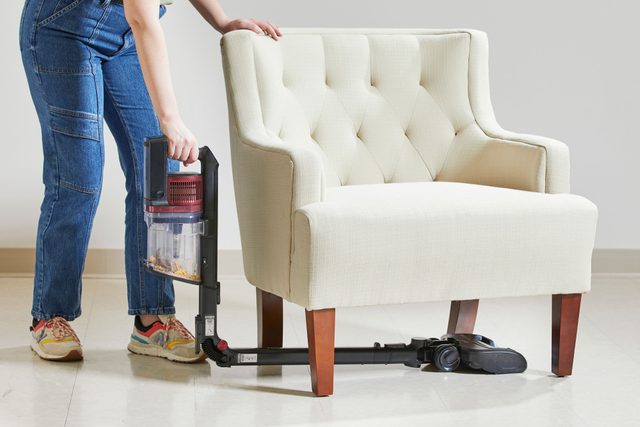
LED lights guide the way in low-light spaces like closets and under furniture, and the clearance of the Stratos is by far the most impressive out of the entire Shark cordless vacuum lineup, being just shy of three inches. This makes it great for getting under couches and maneuvering around table legs. In addition, we found that its agility didn’t dampen the suction, which easily picked up large debris on both high- and low-pile carpets.
Apart from the impressive suction, the Testing Team notes that the wheels help it readily glide over higher-pile carpet, making it easier to navigate than many of the other brands we’ve tried. Intuitive cleaning instructions and a robust battery that lasts over 40 minutes bolster this winner’s performance. There’s no need to rush to clean in less than an hour, either—the removable battery means opting for a second one doubles the cleaning time.
Those looking for an equally impressive performance without the bells and whistles should snag the Shark Vertex instead. It offers similar features and a similar price without the additional attachments.
Best Budget
Shark Cordless Pro
Pros:
- More affordable option
- Multi-purpose pet tool
- Sense IQ included
- Edge-to-edge capabilities
- Lightweight
- Quick assembly
- Easy storing
Cons:
- Didn't perform as well as the Stratos
- Hair tends to wrap up on brush roll
Weight: 7.25 lbs. | Run Time: 29 min | Bin Size: 0.72 qt. | Attachments: Crevice Tool, Brush Combo Tool, Pet Brush-Tool | Converts to Handheld: Yes
While the Shark Stratos performed the best overall, it also comes at the highest price point. For a budget pick, we prefer the Shark Cordless Pro. The Cordless Pro isn’t as robust as the Stratos, but it comes with similarly show-stopping features. Plus, at a full $100 cheaper, it’s also much more affordable.
Sense IQ automatically adjusts suction to tackle bigger messes, and a lit control panel indicates power level and simplifies switching between hard surface and carpet modes. On tile, this pick offered solid performance—it doesn’t push around larger debris like cornflakes, as do other brands we tested. It’s also passable on carpet, though we recommend springing for the Stratos or the Pet Plus if you have more carpet than tile or hardwood in your house.

We appreciate the inclusion of the multi-purpose pet tool, which impressed us with its wide-head brush and flathead options. Both sucked so much dust from our dusty dining chair that it actually changed the color of the upholstery to a whiter white. Overall, this was our favorite of all the Shark attachments.
Just like the Stratos, the Shark Cordless Pro easily converts to a handheld vacuum. This is super handy for tackling shelving and eliminating debris from couches and crevices. A manual boost function bolsters its performance when faced with especially high carpet or big pieces of debris. Overall, it’s a bit of a bust on extremely hairy floors (hair tends to collect and wrap in the brush roll), but it’s a solid pick for households without pets.
Best for Pets
Shark Pet Plus
Pros:
- Hair does not wrap up in brush roll
- Most impressive attachments
- Smooth over carpets, swivels well with good control
- LED headlights
- Slider button to switch between power settings
- Can be stored upright
- More affordable option
Cons:
- Does not perform as well on tile
Weight: 7.45 lbs. | Run Time: 19 min | Bin Size: 0.34 qt. | Attachments: Upholstery tool, Anti-Allergen Dust Brush, Crevice Tool | Converts to Handheld: Yes
At a full $150 less than the price of the Shark Stratos, the Shark Pet Plus makes up for its more modest performance with its fleet of pet-centric features. An upholstery tool de-furs furniture, while an anti-allergen dust brush and crevice tool pull up dander with ease. Like the other best Shark cordless vacuum cleaners on this list, it also boasts two handy LED headlights that highlight errant hair.
A pull-trigger boost mode gives a little more control over extra dirty digs, especially when used in conjunction with the upholstery tool. One area the Pet Plus struggles with is tile. Instead of picking up debris, it pushed most of it around. That said, it operates nearly flawlessly on both high- and low-pile carpet and kitchen rugs, snatching up hair and debris without clogging the brush roll.

Despite having smaller wheels than its pricier cousins, this pick glides readily over most carpet and easily maneuvers around furniture and under tables. It’s similarly easy to clean, with all filters coming clean with plain running water.
Given the lower price point, we’d say this is a solid choice for anyone expecting a vacuum that works incredibly well on pet hair, carpets and upholstery. Those looking for a machine that operates equally well on tile should spring for the more luxurious Shark Stratos or utilitarian Cordless Pro.

Best Splurge
Shark PowerDetect Clean & Empty System
Pros:
- Docking station with automatic bin emptying
- Auto Detect setting for intelligent dirt pickup
- Forward and backward suction
- LED headlights on front and back
- Handsome LED screen
- Odor lock for onboard dustbin
- Propels itself over carpet and hard floors
Cons:
- Pricier than the others
- Only one attachment dock included
Weight: 7.96 lbs. | Run Time: Up to 70 min (on eco mode) | Bin Size: 0.74 qt (plus emptying bin) | Attachments: Pet Multi-Tool, Crevice Tool | Converts to Handheld: Yes
As the highest price point of the bunch, the Shark PowerDetect Clean and Empty System has a lot to prove. However, it passed our at-home testing evaluation with flying colors, securing its spot as the best splurge option. It boasts similar performance as the Stratos, but with a trove of new features. I personally tested this one and came away incredibly impressed overall by the auto-empty system and sheer power of this pick.
Wheels and a powerful motor propel it forward over nearly any floor type, including wood floors, tile and my stiff, tough-to-clean carpet. It also utilizes suction as it moves both backwards and forwards—something even the Stratos can’t do. Additionally, the hinged handle allows it to slide seamlessly under furniture.

LED lights illuminate both in front of and behind the vacuum, ensuring that each piece of debris is accounted for. I also applaud the dual brush roll system, which didn’t once clog up with my long hair or my cats’ fur. The vacuum’s smart Auto Detect setting adjusts suction based on floor type, amount and type of debris and edges/corners. It also can tell when the vacuum moves backwards and adjusts the suction accordingly.
In terms of attachments, it comes with a convertible pet brush tool that doubles as a standard handheld head, plus the dusting crevice tool that made an appearance with most of Shark’s vacuums. There’s onboard accessory storage, but only for one accessory at a time, which is a bit of a bummer. None of the accessories are necessarily showstoppers, but the pet brush did an impressive job of pulling deeply-woven cat hair from my modular sofa.
The real game changer is the auto-empty bin. Upon docking the vacuum, it suctions out all of the dirt and debris for the dustbin and stores it onboard the charging station. You can also set it to quiet mode with a quick switch flip, which pauses emptying. The onboard dust bin can hold around a month’s worth of dirt and debris and only needs emptying on occasion, and a deodorizer cartridge ensures the dust bin doesn’t smell in the interim. I love that the vacuum is always ready to go—no emptying required!
Other Shark Vacuums We Tested
- Shark Vertex: Our Product Testing Team liked the performance of the Shark Vertex. When testing the vacuum across vinyl and carpet, it did a solid job sucking up glitter and cornflakes. The Shark Vertex is very similar to the Shark Stratos listed above in terms of design and included features. However, our team determined the Stratos ultimately performed better than the Vertex.
- Shark Pet Cordless: The Shark Pet Cordless had difficulty picking up glitter and cornflakes on vinyl and low-pile carpets. While it cleaned the high-pile carpet better, it still struggled to pick up messes in corners and along the wall. If you have a lot of area rugs in your home, this Shark vacuum may be a solid budget pick for you. The single-brush roller has a higher profile that works well on carpet but not as well on hard surfaces.
What To Look for When Buying a Cordless Vacuum

Apart from intuitive features, myriad attachments and powerful suction, the best Shark cordless vacuum cleaners are easier to handle than traditional upright vacuums. According to cleaning professional and Director of the Indoor Health Council, Allen Rathey, cordless vacuums “are more portable than corded models, with less trip hazard, and potentially enable more cleaning, although not always better cleaning as they are usually less powerful than corded models. Cordless vacuums excel on stairs, though caution is needed as you are toting some weight.”
According to Allen, you should first consider your flooring type. “Carpeting and tile require different toolsets and capabilities,” he says. “Carpet in homes needs both suction and powered agitation, while tile mainly needs powerful suction directed through a static brush tool having a narrow opening to increase air velocity.”
Attachments
He also says that attachments should play a large role in your final choice. “For general carpet care, a powered brush roll attachment or beater-brush head is important to loosen soils for removal from cut pile carpet, and a powered hand-held brush-roll attachment helps with pet hair.”
Household Needs
Other important aspects to consider include whether your family suffers from allergies, pet hair or other health-related needs and—of course—your budget. “Read reviews and test the vac you are considering before you buy it. If you can’t borrow the vacuum to test, then buy one from a retailer with a good return policy,” he says.
Price
Not sure where you fall in the Shark vs. Dyson debate? One place where Shark vacuums shine is their value. While Dyson vacuums offer scientifically backed machines with an excellent reputation for quality, their products often tip towards four-figure price points. On the other hand, Shark tops out at around $550 for even their luxe models—which is closer to the price of Dyson’s budget line.
How We Found the Best Shark Cordless Vacuum Cleaner

Our expert Product Testing Team tested five popular models of Shark vacuums in our Product Testing Lab. We looked at the following considerations, creating a detailed profile for each and ranked each product a total numbered score out of 30. Points accumulate in the following areas:
- Packaging and setup
- Specs and features
- Performance
- Accessories
- Cleaning and emptying
- Value
To begin with, we examined what arrived in the box and the condition of the packaging. We then noted assembly time and observed the time it takes to charge each battery. Then, we examined the weight of each vacuum and its decibels while running in different modes.
We noted extras like lights, HEPA filters, LED screens and whether it converts to a handheld. Visual considerations like attractiveness and color selection also weigh into our overall score. We also considered accessories and their performance, like between cushions and on dusty shelving.
To assess overall performance, we opted to test a handful of different debris. These include cornflakes, glitter and real human hair (yes—really!). We tested each on tile and high- and low-pile carpet (except hair, which was only tested on carpet). Lastly, we followed the manufacturer’s cleaning and emptying instructions, noting any difficulties in the cleaning process and the effectiveness of the suggested cleaning methods.
After examining each vacuum’s performance, we decided if it was worth the price, which determined its value rating. From there, we looked at each vacuum’s total score and picked the best options for this piece.
Additional Testing in 2025
In 2025, we revisited this piece to see how our top picks are holding up and try a new option: the Shark PowerDetect Clean and Empty System. The PowerDetect is Shark’s priciest model yet, so we were curious to see how it stood up against our favorite Shark cordless vacuums from the original in-lab testing. Overall, it impressed our editor with suction that matches the Stratos, plus a trove of new features that makes it well worth the hefty price tag. Because of this, the PowerDetect Clean and Empty System earned a spot as our favorite splurge option.
FAQ
How do you clean a Shark cordless vacuum?
Press the release button near the handheld vacuum to remove the dust cup from the handheld vacuum nozzle. Rinse filters with water only and allow to air-dry completely for up to 48 hours before reinstalling. The number of filters and their location depend on the model.
How do you charge a Shark cordless vacuum?
Simply plug the charger into the port on the vacuum to charge it. It’s usually located at the top near the handle.
How do you remove a roller brush from a Shark cordless vacuum?
Some rollers on Shark vacuums are fixed in place, so they cannot be removed for cleaning. To properly remove and clean the brush roll, it’s best to check the user manual for your model.
Which Shark vacuum has the strongest suction?
It’s tough to measure how strong a vacuum cleaner’s suction is, but all of the Shark vacuums performed decently well in our cleaning tests. If you’re looking for super powerful suction, we recommend our top pick, the Shark Stratos.
Is Shark PowerDetect worth it?
In our testing, we determined that the Shark PowerDetect clean and empty system is well worth it. Features like the self-emptying dust bin, forwards and backwards smart suction and front and rear headlights justify the rather high price point.
Why You Should Trust Us
Our testing team has years of combined experience testing and evaluating everything from the best toasters to the best flower delivery services. Our product testing experts spent around 40 hours conducting firsthand research in our Testing Lab, including sourcing and researching products. We strive to recommend the best products using honest and fair testing practices and never recommend a product we don’t love, regardless of how popular or big the brand is.
In order to inform this article, we spoke to Allen Rathey, an educator specializing in healthy facilities. He has assembled an advisory group of scientists, PhDs, facility and public health experts who share his passion for helping people everywhere create and maintain safe, healthy indoor environments. Rathey is also past-president of The Housekeeping Channel (HC), The Healthy House Institute (HHI), The Healthy Facilities Institute (HFI), and current Director of the Indoor Health Council (IHC). He is the principal of Winning Environments, LLC, promoting best practices that enhance the living, working and learning environment.
The post Tested and Reviewed: The Best Shark Cordless Vacuum Cleaners appeared first on Taste of Home.
]]>The post Tested and Reviewed: The Best Dyson Cordless Vacuum for Every Space appeared first on Taste of Home.
]]>Best Overall Dyson Cordless Vacuum
Dyson Gen5outsize
Pros:
- Large collection bin
- Slick LCD screen
- Multiple attachments
- Easy emptying system
- Eliminate tufts of long hair
- Includes second battery
- Sleek, minimalistic design
Cons:
- Poor clearance due to larger head
- Pricey
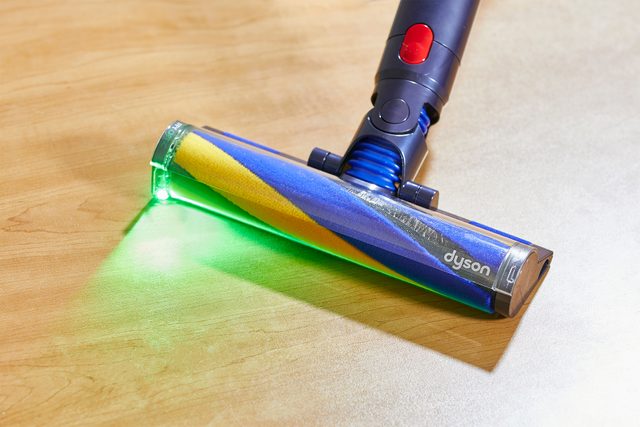
After putting four Dyson models through rigorous testing in our Product Testing Lab, we chose the Dyson Gen5outsize as the overall best Dyson cordless vacuum. This pick not only performed well on all surfaces (including low- and high-pile carpet and tile), but it also impressed with its fleet of attachments, sleek LCD screen and enormous dust collection bin.
Like the rest of the vacuums, we put it to the test against a fleet of opponents, including glitter, cornflakes and real human hair. Its performance was impressive, successfully sucking up most everything in its path. Even big tufts of hair were no match for the tangle-free head. On high-pile carpet, it did struggle a bit with larger debris and was a bit difficult to push, but in a way that indicates it’s working hard. On low-pile carpet and tile, it performed beautifully. It’s a great pick to keep kitchen rugs looking like new.
One of our favorite aspects is the huge arsenal of attachments, including a second battery (!!!), a Fluffy Optic cleaner head with dirt-illuminating headlights for dim spaces, a hard screw tool, a combination tool that tackles dust and upholstery and a built-in crevice tool. Another is the slick LCD screen on the top of the vacuum that allows you to adjust the power level, see battery life and dive into stats regarding the current vacuum session (i.e. types of particles sucked up and the total amounts).
While it impressed with its performance, it was difficult maneuvering the larger head around tight spaces like between furniture, and the clearance was the worst of all the vacuums. However, the tradeoff is that the sizable footprint effectively cuts down on the number of passes required in large areas. Because the “joint” on the vacuum is looser, it’s easier to control than the others we tested, too.
Weight: 8.55 lbs. | Run Time: 26 min | Bin Size: 0.5 gal. | Attachments: Hair Screw, Built-in Crevice Tool, Combination Tool, “Fluffy Optic” Head | Converts to Handheld: Yes
Best Dyson Cordless Vacuum for Pet Hair
Dyson Outsize Plus
Pros:
- Extra large head deep cleans pet hair
- Cordless vacuum with docking station
- Two batteries for extended run time (up to 120 minutes)
- Detangling vanes that prevent hair from catching
- Laser-beam feature detects tiny particles
- Multiple attachments, including Hair Screw Tool and Crevice Tool
- Smart display
Cons:
- Must hold power button to operate
- Heavy, does not stand on own
When it comes to vacuums for pet hair, Dyson offers a few solid options. However, we deduced that the very best Dyson cordless vacuum for pet hair is the Dyson Outsize Plus. Featuring a 150% bigger bin and a 25% wider cleaner head than the Dyson V11, this cordless cleaning machine can easily snatch up even the biggest pet hair messes.
“It’s bad enough that my pit bull mix, Ernie, sheds a lot, but his fur actually weaves deep into carpet and upholstery as if it were part of the fabric,” says Nancy Snyder, Former Pets Senior Shopping Editor. “Most vacuums and pet hair removers simply don’t discern between the two.”
The Dyson Outsize Plus performs well in this regard, eliminating Ernie’s hair from deep within the fabric of her couch. “I also tested the hair-suctioning power of the Digital Motorbar XL on a strip of carpet and was amazed and embarrassed after seeing how much pet hair was pulled into the bin,” she says.
A hinged body lets it bend down low to sneak under couches and beds, and the extra-large head with detangling vanes prevents a clogged mess. Like some of the other options on this list, this model comes with a hair screw tool for upholstery, along with a soft nylon dusting brush and combination tool.
Weight: 17.5 lbs. | Run Time: Up to 60 min | Bin Size: 0.5 gal. | Attachments: Hair Screw, Crevice, Combination Tool, Mini Dusting Brush | Converts to Handheld: Yes

Best Dyson Cordless Vacuum for Allergies
Dyson V11 Torque Drive
Pros:
- HEPA filter
- Cordless
- Easy to use and charge
- Three cleaning modes
- Several attachments
- Low-profile head
- Long battery life
- 2-year warranty
Cons:
- Hold-down trigger may be difficult to use
- Pricey

Those with allergies know that a vacuum that spreads around dust and particulates isn’t an option. That’s why we recommend the powerful and lightweight Dyson V11 to cut through allergens. Able to convert to a handheld, this lean, mean cleaning machine boasts a HEPA filter and built-in Dynamic Load Sensor system, which automatically adjusts between floor types. This means that whether we’re talking dirt or dust, it’s dead meat.
Like the other options on this list, it comes with mounting hardware that makes it so easy to pack up when chores are done. Used in tandem with an air purifier, the Dyson V11 makes allergies a problem of the past. Senior Editor Katie Bandurski gives it high marks after testing it for her full review of the vacuum.
“First, I vacuumed the hardwood floors in my apartment on Eco mode. I was impressed (and slightly horrified) with how much dust and hair the Dyson picked up,” she writes. “I consider myself a fairly clean person, but this machine had so much more power compared to the vacuum I previously used. But what really sold me was how clean my apartment felt after just one use. I suffer from allergies, and there’s nothing more satisfying than picking up dust and placing it in the trash where it belongs.”
“I’ve been using Dyson’s V11 Torque Drive cord-free vacuum for over four years now—and I still love it,” she goes on to write. “In that time, I’ve moved from a small studio apartment to a larger two-bedroom to a full house, and the Dyson V11 has kept each space free of dust, dirt and other debris.”
Weight: 6.61 lbs. | Run Time: Up to 60 min | Bin Size: 0.2 gal.| Attachments: Hair Screw, Crevice, Combination Tool | Converts to Handheld: Yes
Best Dyson Cordless Vacuum on a Budget
Dyson v8
Pros:
- Affordable
- Easy-button operation
- Lightweight
- Hair screw and crevice tools included
- Quieter than other models
- Dust chamber is easy to clean
- Washable filter
Cons:
- Only two settings: Low and Max
- Small collection bin

“Budget” and “Dyson” are rarely synonymous, but the Dyson v8 is the most inexpensive of all the Dyson models we tested. While more basic than the others, it impressed with a lightweight design, uncomplicated settings and stellar performance when maneuvering around furniture and under couches. As a bonus, it was also the least noisy pick of the bunch.
This value vacuum worked very well on carpet, though it’s perhaps a little less successful at sucking up larger debris on vinyl. However, it did eventually accept the larger cornflake pieces when we plopped it down directly on top of them. It even grabbed nearly all of the glitter and most of the cornflakes on carpet.
When used on low power, the crevice tool offers decent performance. However, we suggest sticking to the low setting as the high setting quickly surged, shut off and smelled like it was burning. Similarly, the vacuum itself definitely doesn’t feel as powerful as the overall best pick, but it’s still a solid choice for families that don’t deal with daily spills or pet hair.
With stellar performance on carpet and edge-to-edge cleaning capabilities, it’s a valuable addition to any eco-friendly cleaner’s arsenal.
Weight: 5.5 lbs. | Run Time: 29 min | Bin Size: 0.14 gal. | Attachments: Hair Screw Tool, Crevice Tool, Dusting Tool, Combination Tool | Converts to Handheld: Yes

Best Dyson Cordless Vacuum for Small Spaces
Dyson v12 Detect Slim
Pros:
- Small head performs well in tight spaces
- Lightweight
- Sleek LCD screen
- Automatically adjusts suction
- Dust cup easy to wipe down
- Performs well on carpet
Cons:
- Small waste bin
- Suction too aggressive for area rugs

Our final recommendation, the Dyson V12 Detect Slim, is one powerful-yet-compact pick that works perfectly for smaller spaces. Apart from the inclusion of the standard crevice tool and combination and hair screw tools, we appreciated that the “Fluffy Optic” head (which we loved from our top Dyson pick) also comes with this model.
It’s the lightest and slimmest of all the Dyson cordless vacuums, earning its place as the best option for apartments and other tight spaces like small living rooms. At only 5.25 pounds, it’s easy to carry from room to room thanks to the smaller waste container. While it didn’t impress with its performance on tile, this is a solid choice for both high- and low-pile carpet.
This was the easiest Dyson dust cup to wipe down because of the way it was oriented (i.e., the stubborn rubber rings present on all the vacuums were easier to access and clean). Also, this is the only filter that actually had anything on it, so it certainly does its job!
The real selling point is the stellar performance, though—it performed almost as well as our top pick, only suffering from a few setbacks when faced with the cornflakes on high-pile carpet. Overall, this is a smart choice for anyone looking for a lightweight vacuum that lasts.
Weight: 5.25 lbs. | Run Time: 29 min| Bin Size: 0.09 gal.| Attachments: “Fluffy Optic” Head, Hair Screw Tool, Crevice Tool, Combination Tool | Converts to Handheld: Yes
What to Look for When Buying a Cordless Vacuum
According to Allen, important considerations include suction, dirt capacity, weight, ergonomics, noise, a battery life greater than 20 minutes and easy emptying. “Ergonomics is an important consideration since on-board batteries are typically heavy,” he advises. “Given the additional weight often associated with onboard batteries, consider vacuuming part of your daily workout, and have fun!”
Allen also mentions that filtration type is often most important for household members have allergies or sensitivities. “HEPA final filters are important for fine dust capture but should be balanced with pre-filters to intercept ‘boulders’ (relatively larger dust particles that will quickly clog the system),” he says.
In order to narrow down your options, think about the most important aspects in your home. Taking into account allergies, pet hair, the amount of space available and the type of flooring in your home helps determine which model best fits your lifestyle.
How We Found the Best Dyson Cordless Vacuum Cleaner
In order to find the best Dyson cordless vacuum, our expert Product Testing Team tested four popular models in our Product Testing Lab. We looked at the following considerations in order to create an accurate and detailed profile on each vacuum:
- Packaging and setup
- Specs and features
- Performance
- Accessories
- Cleaning and emptying
- Value
In order to score high marks in packaging and setup, we looked at what arrives in the box and each component’s arrangement, along with the package condition upon arrival. From there, we took note of ease of assembly and the time it takes to charge each vacuum’s battery from 0-100%.
For specs and features, we looked at the weight of each vacuum, measured the decibels each puts out while running and notable features like lights, HEPA filters, LED screens and whether it converts to a handheld. We also analyzed visual aspects, such as how attractive the vacuum looks and whether it comes in multiple colors. Similarly, our analysis of the included accessories considered ease of assembly and performance between cushions and on dusty shelving, where applicable.
Overall performance is the most important consideration. We opted to test a handful of different debris including cornflakes, glitter and real human hair (yes—really!). We monitored how well each vacuum sucked up the cornflake and glitter debris after three passes on tile, high- and low-pile carpet. We only tested each vacuum’s performance with human hair on carpet. Other data points we tested for include how long the battery lasts, maneuverability around furniture and clearance under furniture.
Lastly, we followed the manufacturer’s cleaning and emptying instructions. The testers tried emptying the canisters hands-free. They noted any difficulties in the cleaning process and the effectiveness of the suggested cleaning methods.
Looking at each vacuum’s performance, we then decided if its worth the price, which determined its value rating. From there, we looked at the total scores of each and picked the best options for this piece.
FAQs
What cordless Dyson vacuum cleaner should I get?
It depends on a few factors, like your house size, the type of flooring you have, how often you vacuum, how long it takes you to vacuum, and what kinds of messes you’re vacuuming up. All of the cordless vacuums we recommend would work well in most instances, but we like the Dyson Gen5outsize for its well-rounded suite of features that makes it a good choice for just about everyone.
What is the top-of-the-range cordless Dyson vacuum?
That would be the Gen5outsize or Gen5detect line.
Is the Dyson V15 better than the V11?
If you’re looking strictly at build quality and features, yes, the V15 is the better vacuum. It’s lighter, more maneuverable, and slightly more powerful with a longer battery life. But it’s more expensive, and it may be overkill for your needs. The V11 works great for most households.
How do I clean a Dyson cordless vacuum?
The method for cleaning each Dyson cordless vacuum depends on the model, but it’s basically the same across the board. First, remove the cyclone by pulling the bin release catch upwards and push the cyclone release button (behind the cyclone) to remove it from the machine. Remove the bin by pulling back on the red catch located on the base, then slide the bin down and pull it off your machine. Once removed, wipe the bin with a damp, lint-free cloth. Do not put in dishwasher or use detergents, polishes or air fresheners. Dry thoroughly before replacing.
How do I empty a Dyson cordless vacuum?
In order to empty a Dyson cordless vacuum, simply hold the machine over the trash and pull the bin release catch upwards.
How long do Dyson cordless vacuums last?
Dyson vacuums are some of the longest lasting vacuum cleaners on the market, with some customers claiming theirs lasted up to 10 years. As a general rule of thumb, clean your Dyson vacuum between each use to increase longevity and reduce the amount of grime that gets into nooks and crannies. This not only keeps your vacuum looking fresh for years, but it also helps it continue to run at optimal performance.
Why You Should Trust Us
Our testing team has three years of experience testing and evaluating everything from the best toasters to the best flower delivery services. Our product testing experts spend around 40 hours conducting firsthand research in our Testing Lab. Our Product Testing Team busied themselves in the testing lab, sucking up glitter, emptying bins and checking the clearance of four different vacuums for nearly 40 hours in order to determine which is truly the best cordless Dyson vacuum. In addition, we tested two picks in our own homes to see how well they stand up to daily dirt and grime.
In order to inform this article further, we spoke to Allen Rathey, an educator specializing in Healthy Facilities. He has assembled an advisory group of scientists, PhDs, facility and public health experts who share his passion for helping people everywhere create and maintain safe, healthy indoor environments. He is the former president of The Housekeeping Channel (HC), The Healthy House Institute (HHI), The Healthy Facilities Institute (HFI), and current Director of the Indoor Health Council (IHC). He is the principal of Winning Environments, LLC, promoting best practices that enhance the living, working, and learning environment.
The post Tested and Reviewed: The Best Dyson Cordless Vacuum for Every Space appeared first on Taste of Home.
]]>The post Procter & Gamble Is Recalling 8.2 Million Defective Bags of Laundry Detergent Pods, Including Tide Pods and Gain Flings appeared first on Taste of Home.
]]>Here’s what to know before your next load of laundry.
What laundry detergent is being recalled?
Tide recall
- Tide Pods Original
- Tide Pods Spring Meadow Scent
- Tide Pods Light
- Tide Simply Pods Plus Oxi Boost
- Tide Pods Clean Breeze Scent
- Tide Pods Free & Gentle
- Tide Pods Oxi
- Tide Pods Ultra Oxi
Gain recall
- Gain Flings Original
- Gain Flings Moonlight Breeze Scent
- Gain Flings Blissful Breeze Scent
- Gain Flings Spring Daydream Scent
- Gain Flings Plus Ultra Oxi
- Gain Flings Plus Odor Defense
Other brands
- Ace Pods Clean Breeze
- Ace Pods Spring Meadow
- Ariel Pods Alpine Breeze
This recall affects only laundry detergent pods sold in bags. The products in hard plastic tubs are fine.
Why is Procter & Gamble recalling detergent pods?
P&G says the packaging can split open near the zipper track, posing a risk of injury to children and vulnerable adults if they accidentally eat the laundry detergent packets. It happens—so far, four curious kids have accessed the liquid laundry packets, three of which reported ingestion.
How do I know if I bought recalled pods?
To see if your specific Tide, Gain, Ace or Ariel bag is part of the recall, check the lot code on the bottom of the bag. Recalled lot codes will be listed at pg.com/bags.
What should I do next?
The laundry detergent itself is still safe to use, but store the bags out of sight and reach of kids. If you have a Tide Pods or Gain Flings tub handy, transfer the packets to that tub. Then, contact Procter & Gamble via pg.com/bags for a full refund and a child-resistant bag to store the product.
The post Procter & Gamble Is Recalling 8.2 Million Defective Bags of Laundry Detergent Pods, Including Tide Pods and Gain Flings appeared first on Taste of Home.
]]>The post I Tried the Farberware Countertop Dishwasher and Dishes Take Me a Fraction of the Time appeared first on Taste of Home.
]]>Unable to look at one more food-crusted fork, I was desperate for a solution. Enter: the countertop dishwasher. I jumped at the chance to test out the popular Farberware model, but would the appliance make my life easier, as I’d hoped?
What is the Farberware Countertop Dishwasher?

This Farberware dishwasher is an appliance that sits on a surface such as a table or countertop and simply plugs into a wall. Because of this, its capacity is significantly smaller. The machine can fit just a few place settings at one time and holds dishes with a 12-inch diameter or smaller. The overall footprint is 22 by 20 by 17 inches, and it weighs 43 pounds.
The Farberware countertop dishwasher is intended for those who live in RVs, dorms, studios or other small apartments. Regardless of location, it’s best for one- or two-person households. (Psst! See more small appliances.)

We Tried It
Farberware Countertop Dishwasher
The compact dishwasher has wash programs that leave your dishes clean and you with more free time.
Farberware Countertop Dishwasher Features
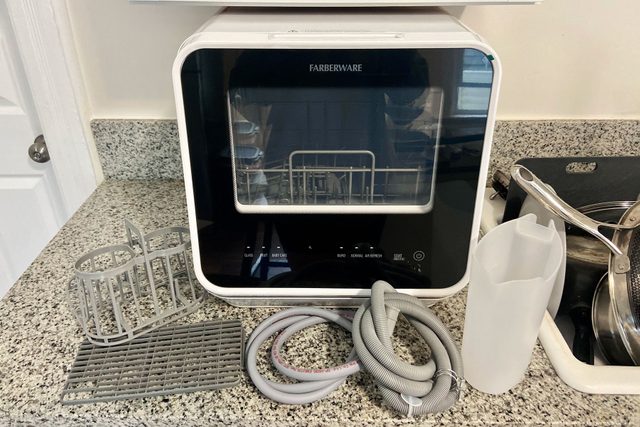
I’ve compared various countertop dishwasher models, and in my opinion, the Farberware one has all the essential features. For one, it doesn’t require a faucet hookup. Although that option is available, the 5-liter tank may also be filled manually with the provided pitcher before each use, making the machine extra versatile and portable. In addition to the pitcher, the dishwasher also comes with a rolling rack, clip-on silverware tray, baby bottle holder, drain hose and faucet supply line. Note: I did not receive the fruit basket that’s currently available.
Moreover, there are various functions: normal, rapid, glass, fruit, baby care and air refresh. Although I haven’t had the use for most functions, I’ve noted that the normal cycle, which takes just over two hours, includes drying, whereas the 40-minute rapid cycle does not. I much prefer the former. I use liquid dishwasher detergent, but pods work, too.
When you’re all set, the door latches via magnetic strips, plus it has a window so you can follow along with the progress (my cat is a big fan of this feature!).
How We Tested It
Set-Up
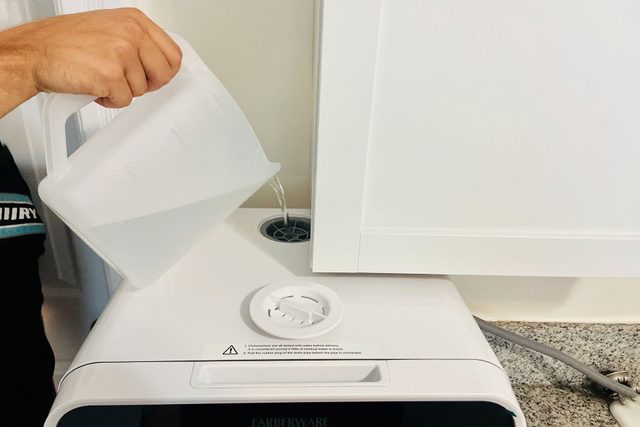
I’ve used the Farberware countertop dishwasher almost daily for three months. Assembly upon reception was effectively nonexistent because I didn’t hook it up to our faucet right away. All that was required was unpacking the accessories, which were neatly situated within the rolling rack; connecting the drain hose to the back of the machine, then snaking it into a nearby sink; and plugging the dishwasher into the wall.
For the first two months, I manually filled the water tank via the provided plastic pitcher. Although this method makes the dishwasher more universally usable, it does get old after a while. The pitcher holds less than two liters of water, so it requires three trips to fill the tank. Plus, the opening to the cavity in which you pour the water is small and lends itself to spillage.
That being said, the dishwasher was convenient enough to make these gripes worth it. I didn’t fall in love with the appliance, however, until I hooked it up to my kitchen faucet. If this is an option for you, I’d highly recommend it. It makes me feel like I have a standard dishwasher at my service.
Use
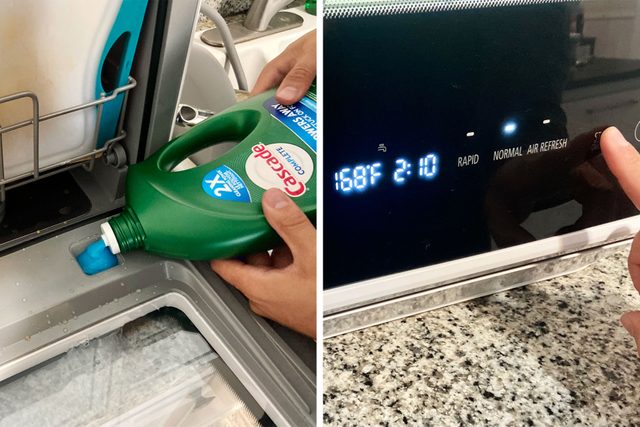
I most often employ the rapid and normal cycles. The rapid cycle takes under an hour, but the water doesn’t get as hot and the dishes aren’t dried. The normal cycle is lengthy, but I typically do dishes right before bed, so I don’t mind it running throughout the night to have mostly dried dishes in the morning. While running, it’s surprisingly quiet, and the alarm that sounds upon completion isn’t overly disruptive. The normal cycle takes two hours and 10 minutes, and temps reach well over 150 degrees.
On those lighter days in which I’m not meal-prepping and creating tons of dirty pots and pans, the dishwasher holds roughly an entire day’s worth of plates, bowls, cups and cutlery. The silverware rack, especially, fits a surprising amount.
After I’m done loading the rack, I squeeze a dollop of liquid detergent into the designated compartment on the backside of the door and let it do its thing. I typically have a few additional dishes to take care of by hand, like those that aren’t dishwasher-safe or are too big. But, in all, I’d say the Farberware dishwasher cuts the amount of time it takes me to do my dishes in half.
I’ve never had any issues with stuck-on food (granted I do thoroughly rinse dishes before adding them to the dishwasher). There have been instances, though, of small amounts of dried coffee and melted cheese readily washing away. It does a bang-up job that’s comparable to that of any full-size dishwasher.
Pros
- No hookups required
- Included accessories (water pitcher, baby bottle holder, fruit colander)
- Easy touchscreen with five wash programs
- Drying capabilities
- Sleek appearance with see-through window and LED lights
- More compact than most other models
Cons
- Not compatible with rinse aids
FAQ
How much water does a Farberware countertop dishwasher use?
The Farberware countertop dishwasher uses 5 liters of water per wash cycle, regardless of the program selected. It will need to be filled, either manually or via the faucet supply line, each time you use it. This compares to the 4 to 14 gallons of water used by full-size dishwashers (granted, they are cleaning more dishes). Additionally, hand-washing dishes can use as many as 27 gallons of water per full-size dishwasher load.
How does a countertop dishwasher drain?
This Farberware countertop dishwasher, specifically, drains by way of a hose, which screws and clamps onto the back of the machine. It’s more than 50 inches long, so the dishwasher does need to be somewhat close to a sink, but it’s bendable and inconspicuous to make the connection more manageable. The hose is also fitted out with a suction cup so that it can be secured in place to the wall or base of the sink.
Product Comparison
As I mentioned, I believe the Farberware countertop dishwasher to have the best parts of all its competitors. For example, it doesn’t require a faucet hookup like some others. It has drying capabilities, which not all can boast. And its wash programs and accessories are on par. Additionally, it’s similar in size to or smaller than other models, like, say, the Black+Decker one. Most countertop dishwashers cost between $200 and $500. At $280, this Farberware dishwasher is solidly in the middle. Plus, its touchscreen, windowed door and overall sleek design make it more attractive than most.
As compared to standard dishwashers, it’s, of course, cheaper, but it’s also much smaller. Standard dishwashers can clean more than a dozen place settings at one time, whereas the Farberware countertop dishwasher can only handle two or three. That being said, the Farberware model is not meant to take the place of a standard dishwasher but rather serve as a shortcut solution for those who don’t have access to or the means for one.
Final Verdict
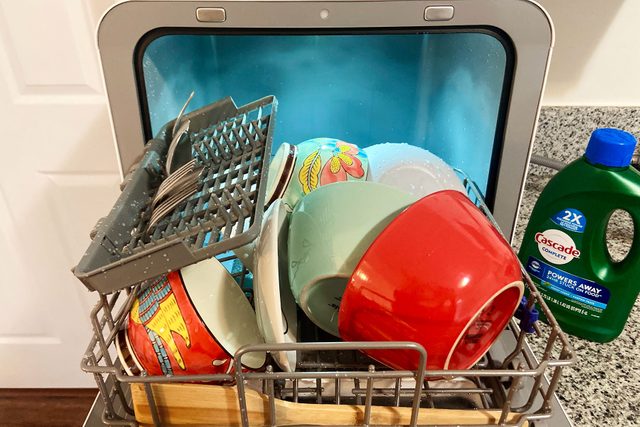
Not to sound dramatic, but I don’t want to remember a time before my Farberware countertop dishwasher. In a perfect world, it would probably hold more dishes and dry them slightly more effectively, but the appliance has made a dreaded daily chore far less burdensome. It’s such a relief to have a place to toss things like coffee mugs, small cutting boards and cooking utensils where I know they’ll be cleaned thoroughly and quickly.
If you can hook up the dishwasher to your faucet, I’d recommend this to anyone who might think that have a use for it, whether they’re a college student, RV-dwelling retiree or young urbanite. If you only can fill it up manually, I’d first gauge how much you dislike doing dishes before adding it to your cart because, truthfully, it might not save you much overall time, more so the need to get your hands dirty.
Where to Buy the Farberware Countertop Dishwasher
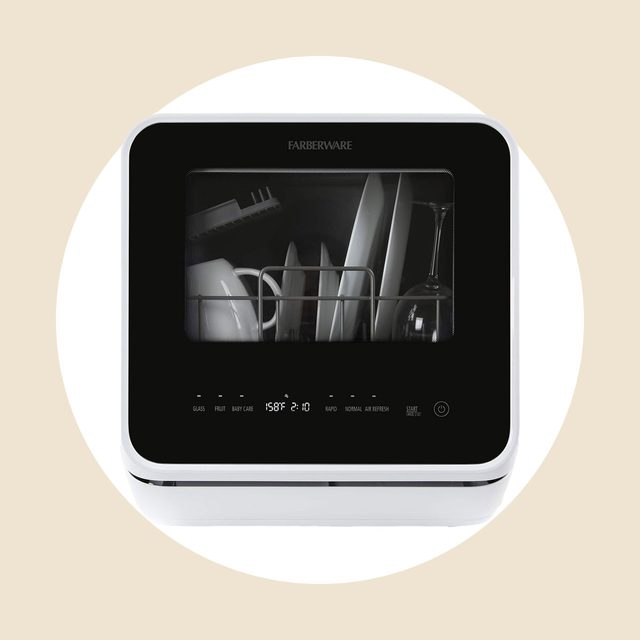
We Tried It
Farberware Countertop Dishwasher
The Farberware countertop dishwasher fits atop most kitchen surfaces and washes dishes like its full-size counterparts.
The Farberware countertop dishwasher is available from Amazon, Home Depot and Wayfair for $280. If you like to spend your time in the kitchen cooking rather than cleaning, then this appliance is the sidekick you need.
The post I Tried the Farberware Countertop Dishwasher and Dishes Take Me a Fraction of the Time appeared first on Taste of Home.
]]>The post 5 Simple Holiday Cleaning Tips from Babs Costello, ‘The Internet’s Grandma’ appeared first on Taste of Home.
]]>That’s where “everyone’s grandmother,” aka Babs Costello, saves the day. Because, of course she does! 74-year old TikTok sensation @brunchwithbabs) has share all types of household hacks, in and out of the kitchen. Her tips cut our pumpkin carving time in half this Halloween. Now, let’s say goodbye to pesky water rings and stains after Thanksgiving, Christmas, and New Years, the Babs way.
5 Tricks to Help Clean Up After Your Guests
“Are you planning any holiday get-togethers?” Babs asks. If so, follow these holiday cleaning tips that are fully grandma-approved.
Remove water rings with mayonnaise
It can be a pain to constantly remind guests to use a coaster. And, let’s face it, water rings on surfaces during a gathering are inevitable. Babs tells us not to sweat it. Just grab a couple paper towels and dab some mayonnaise on the water ring. Yes, mayonnaise! Don’t clean it up right away. Instead, leave the paper towel over the stain for a few hours or as long as overnight. Then apply furniture cleaner for extra polish. Voila, stain be gone.
One commenter endorsed the trick, saying the water ring “was gone in the morning” after leaving the mayo overnight. I’m adding this to my go-to cleaning hacks, immediately.
Get rid of red wine stains with white wine
It’s devastating to see red wine stains on the carpet. Luckily, Babs works her magic by removing the stain with…white wine! Babs advises pouring “just enough to cover” directly onto the stain before blotting with a clean cloth or paper towels. If the stain persists, sprinkle baking soda on top. Let it sit for five minutes, vacuum it up and blot again. Finish with dish detergent and water-soaked paper towels.
Bonus: This trick also works on tablecloths!
Hand-wash wine glasses for a spotless finish
Save dishwasher space “and get the glasses spotless,” Babs says. First, wash and dry the glasses individually rather than loading them into the dishwasher. Put the glasses in warm soapy water and hand wash to get the rims nice and clean. Sanitize glasses by draining the sink, refilling it with warm water and adding 1/2 cup of white vinegar. Soak the glasses for around five minutes, then rinse and dry.
Use a cheap homemade surface cleaner
Put your spotless wine glasses on spotless surfaces! Babs shares this recipe for homemade surface cleaner: “two parts water to one part white vinegar, [and] stir,” before pouring into a spray bottle. Spray the cleaner onto paper towels or a clean cloth and make your surfaces dazzle.
Keep your floor mop clean
Before you mop, Babs says to wrap a paper towel around your mop head and spray it with a cleaner of choice. (Babs uses Viva paper towels and her own homemade cleaner.) Mop away!
In Babs’ Instagram comments, one fan says, “I want to come to Babs and Mr. Babs house for the next party!” And with holiday cleaning tips like these, we can’t help but agree!
The post 5 Simple Holiday Cleaning Tips from Babs Costello, ‘The Internet’s Grandma’ appeared first on Taste of Home.
]]>The post How to Make Homemade Laundry Detergent So You Never Have to Buy It Again appeared first on Taste of Home.
]]>Buying the individual ingredients and putting them together yourself lets you choose exactly what goes into your laundry detergent. Homemade cleaners can be environmentally friendly too, both in their ingredients and in their packaging. Instead of buying single-use plastic containers of liquid detergent, you can make powdered detergent from ingredients packaged in paper and cardboard and store your final blend in a reusable airtight container.
Before You Start
Choose a soap that’s free of chemicals, fragrance and dyes, such as castile bar soap. Washing soda (sodium carbonate), sometimes sold as soda ash or crystals, is just baking soda (sodium bicarbonate) that has been heated to remove its natural moisture. It absorbs odors and brightens fabrics.
A few optional ingredients boost basic laundry detergent. Borax, a naturally occurring salt, acts as a softener and helps remove stains. However, a high pH makes it potentially irritating to skin, so leave it out if you have sensitivities. Keep the blend scent-free or, if you like a fragrant detergent, look for an essential oil at a local drugstore or natural goods store.
The powders in a detergent mix can be quite fine. If you’re concerned about breathing in the particles, put on a mask or choose a well-ventilated or outdoor space for detergent prep. Directly handling large volumes of the dry ingredients can be more irritating to skin than dissolving them in a load of wash, so pull on gloves before you begin.
It can be difficult to remove the soapy taste from the tools you use when making detergent at home, so you may want dedicated ones for this project.
How to Make Your Own Homemade Laundry Detergent
@haleigh021 #laundrydetergent #cleantok #moneysavingtips #savemoney #cleaningtips #momtok #momtips #familyof5 ♬ Heart Like A Truck – Lainey Wilson
This recipe yields about six cups of detergent, enough for up to 96 loads of laundry.
Ingredients
- 1 bar of soap, five ounces
- 2 cups baking soda
- 2 cups washing soda
Optional:
- 2 teaspoons Borax
- 6 to 10 drops essential oil, such as lavender or lemon
Tools


- Cheese Grater: Choose a grater that will give you fine shreds of soap. The finer the shreds, the more easily the soap will dissolve in water.
- Large Mixing Bowl: A large, wide bowl lets you stir the lowest layer of powder into the mix without creating a cloud of particles.
- Half-Gallon Mason Jar with Lid: An airtight lid on a glass jar or other storage container will help prevent clumping.
Directions
Step 1: Grate the soap
Using the cheese grater, grate the soap into fine shreds. Measure two cups of soap shreds into a large mixing bowl, storing any extra soap in an airtight container to use in your next batch.
Step 2: Mix in the powders
Slowly pour the baking soda and washing soda into the mixing bowl. If desired, add borax and a few drops of essential oil. Using a large wooden spoon, stir until well combined, using a gentle motion to keep the particles from dispersing into the air.
Editor’s Tip: If you devote a food processor to detergent making, you can create a finer powder with the machine’s grating and blending attachments. After stopping the food processor, let the mixture sit for a couple of minutes, until the dusty powder settles, before opening the lid.
Step 3: Store the detergent
Slowly pour or scoop the detergent into a half-gallon jar and seal it with an airtight lid. Label container and store it in a dry place out of reach of children.
How to Use Homemade Laundry Detergent
On laundry day, measure one or two tablespoons, for a small or a large load, into the drum of your washing machine before adding the laundry and starting the machine. Adding the homemade detergent directly to the washer drum keeps soap flakes from clogging the machine’s dispenser. If you have hard water and notice soap scum, reduce the volume of soap in your next mix.
Homemade Laundry Detergent FAQs
Does homemade laundry detergent go bad?
Laundry detergent won’t spoil, but it can clump and harden. Mixing it frequently in small batches keeps the detergent loose and powdery.
The dryness of washing soda helps minimize the moisture in the blend, but it’s still important to keep the detergent in a tightly sealed container and store it in a nonhumid place. A dry upper cupboard is a better location than under the laundry room sink or on a shelf over the dryer.
Can I use homemade laundry detergent on whites and delicates?
DIY detergent brightens whites and gently cleans delicate clothing, so you can use it on all of your laundry. Adding borax can help tackle tough stains, but as a potential irritant, it may be best left out of detergent for delicates.
Homemade detergent can also be used to pretreat stains, but leaving it on too long might weaken delicate fabrics and affect colors. It’s better to load and start the machine than let fabrics sit overnight against the detergent.
The post How to Make Homemade Laundry Detergent So You Never Have to Buy It Again appeared first on Taste of Home.
]]>The post 6 Ways to Reuse Your Butter Wrappers appeared first on Taste of Home.
]]>When peeled off the stick of butter, the waxy wrappers have a thin layer of butter inside; just enough to put to good use. So don’t throw them out! Here are six ways to use butter wrappers in the kitchen.
How to Save Your Butter Wrappers
Flatten out the butter wrappers and stack them together. Slide the stack into a resealable plastic bag. Stash them in the fridge or for longer storage in the freezer. That way they’ll be handy to grab for all these uses.
These tricks work with all kinds of butter.
How to Use Butter Wrappers
Prevent Splatters When Microwaving Butter

The microwave is a great way to melt or soften cold butter—and the wrapper will keep things tidy while you do it. Use a butter wrapper (except foil ones) to cover the dish holding the butter; it’ll keep your microwave clean by preventing any spatters from escaping.
Cover Leftovers
Tamar Adler, author of The Everlasting Meal Cookbook, shares that butter wrappers are great for covering leftovers in a bowl instead of plastic wrap or when lids go missing. Just press a wrapper, butter side down, to the surface of the food to keep air out during storage.
Grease Cake Pans

Our grandmas taught us this baking trick! The butter left on the wrapper is plenty to grease pans for cakes, cookies and brownies. Rub the butter side of the wrapper over the insides of the pan, especially into the corners.
Separate Frozen Food

When getting foods like cookies, cakes, burgers or chicken fillets ready to freeze, butter wrappers will keep them from sticking together. Just place one between each layer before bagging them up for the freezer.
Lightly Grease Skillets
When your frying pan or skillet needs just a little oil, use a butter wrapper instead of cooking spray. Rub the surface of the pan with the wrapper to lightly coat it with butter before cooking.
Shape Marshmallow Cereal Treats
When crisped rice cereal and melted marshmallows are mixed together, it’s super sticky. Instead of coating your hands with butter or nonstick spray, use a butter wrapper. Spoon the mixture into the pan, then use a butter wrapper to press the mixture down.
The post 6 Ways to Reuse Your Butter Wrappers appeared first on Taste of Home.
]]>